
Which 12th Stream is Best for Law in India?:Science, Commerce or Arts
Home / LAW / Which 12th Stream is Best for Law in India?:Science, Commerce or Arts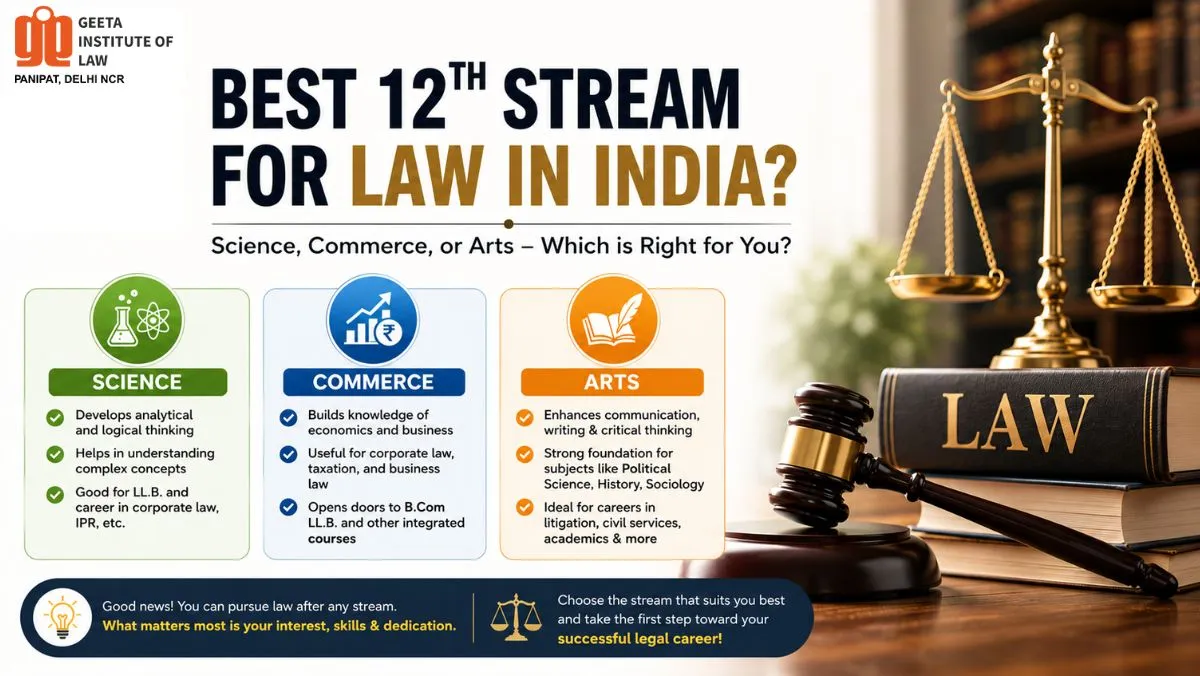
Many students interested in law studies after 12th wonder whether Science, Commerce, or Arts is the best stream for a legal career. The fact of the matter is that none of these streams is better than the other. A student belonging to any of the three can make it big in the law field.
While the Arts stream offers knowledge about issues surrounding society and its governance, the Commerce stream offers opportunities to specialise in corporate and tax laws. But the Science stream can be an added advantage in terms of specialising in areas like patent law, technology law, and environmental law.
Differences Between All Programmes
It is very critical to understand the difference between the different law-related courses prior to enrolling in a specific course. So let’s talk about the big ones of the law-related programmes that students should know.
LLB (Bachelor of Laws): LLB is a 3-year professional course that is undertaken after completion of a Bachelor’s degree in any stream such as BA, BSc, BCom and many more. D.U. LLB Entrance Exam, MH CET Law, ILICAT, AP LAWCET, TS LAWCET and other state-level law entrance exams conducted by respective state bar councils/law institutions are offered to the candidates for which they can appear.
Bachelor of Arts and LLB: B.A.LL.B is a 5-year integrated course after the completion of Class 12 from any stream of education; the course is a combination of arts and LLB. Admission is through CLAT, AILET, LSAT-India or direct admission by the private law colleges based on Class 12 merit score subject to Bar Council of India’s eligibility criteria.
B.Com.LLB/BBA LLB: B.Com.LLB/BBA LLB programme where the students study Commerce subjects along with law studies after 12th, which is suitable for Commerce students who wish to pursue their studies in the field of Corporate Law, Taxation Law and Financial Regulations. Admission is based on merit/CLAT / AILET.
B.Sc.LL.B: A 5-year integrated course that is designed for students who are interested in specialising in Patent Law, Technology Law, and Environmental Law. Admission is made based on CLAT/AILET or on a merit basis.
Candidates who have passed Class 12 with 45% or 40% for SC/ST/OBC/PWd candidates can appear for CLAT. No age limit for CLAT. The qualification for appearing in AILET is a pass mark of 50% (45% for SC/ST candidates) in Class 12.
Also Read: Top Law Colleges in India 2026
B.A.LL.B or B.Com.LL.B Or B.Sc.LL.B: Quick Comparison Table
Students who have just completed their schooling and are thinking about law studies after 12th should go for an integrated 5-year programme. This table provides an insight into different kinds of dual degrees that candidates pursue after completing 12th grade.
| Course Type | B.A.LL.B | B.Com.LL.B | B.Sc.LL.B |
| Stream To Pursue Law After | Arts Or Any Stream | Commerce Stream | Science Stream |
| Course Duration | 5 Years | 5 Years | 5 Years |
| Core Subjects | Political Science, History, and Law | Business Law, Taxation, and Law | Intellectual Property Rights, Technology Law, Environmental Law |
| Career Path | Legal Careers In Civil Law, Criminal Law, and the Judiciary | Legal Careers In Corporate Law, Tax Law, Financial Law | Legal Career In Patent Law, Intellectual Property Rights, Environmental Law |
| Eligibility Criterion | Any Stream (Class 12 pass) | Any Stream, preferably Commerce (Class 12 pass) | Any Stream, preferably Science (Class 12 pass) |
| Top Entrance Examination For Admission Into The Course | CLAT, AILET, LSAT-India | CLAT, AILET | CLAT, AILET |
Opportunities After Completing LLB
Pursuing law studies after 12th gives you unlimited job opportunities not only in India but across the globe. This is because there exist various specialisations in law in India. The following data is sourced from reputed career platforms and law firm placement disclosures:
| Career Opportunities | Initial Salary Per Annum Range | Mid-Salary Range Per Annum | Driving Factors |
| Corporate Law (At Tier-I Law Firms/MNCs) | ₹12,00,000- ₹20,00,000 | ₹25,00,000 to ₹1 Crore+ | Law Firm Tier, Billable Hours, Corporate Transaction Scale |
| Intellectual Property Rights (IPR) | ₹6,00,000 – ₹12,00,000 | ₹15,00,000 – ₹35,00,000 | Technical/Scientific Domain Expertise, Patent Filing Specialisation |
| Civil Judge/Judicial Service Officer | ₹9,00,000 – ₹14,00,000 | ₹18,00,000 – ₹30,00,000 | Fixed Government Pay Scales |
| Alternative Dispute Resolution (Mediator/Arbitrator) | ₹5,00,000 – ₹10,00,000 | ₹15,00,000 -₹45,00,000+ | Case Volume, Arbitration Scale, Mediator Reputation |
| Government Legal Services And PSU Officers | ₹7,00,000 – ₹12,00,000 | ₹14,00,000 – ₹28,00,000 | Fixed Government Pay Structure |
| Academic And Legal Research Careers | ₹5,00,000 – ₹8,00,000 | ₹12,00,000 – ₹24,00,000 | UGC Norms, Tier Of College, Publication Volume, Doctoral Dissertation Completion |
| International Law Careers And NGO Roles | ₹4,00,000 – ₹7,00,000 | ₹12,00,000 – ₹25,00,000 | International Funding, Policy Scale, Organisational Structure |
| Independent Legal Practice/Litigation Advocates | ₹2,00,000 – ₹5,00,000 | Uncapped | Senior Counsel Repute, Client Network, Success Rate In Courts |
Who Should Choose Law?
Individuals willing to opt for studies related to law studies after 12th from any stream can opt for this profession. This profession is apt for those who aspire to be advocates, judges, legal counsellors, and policymakers.
LLB After 12th Arts Stream
Students planning to go for law after 12th arts stream can easily cope with law education due to subjects like History, Political Science, and Sociology, which help in understanding constitutional law, criminal law, sports law, and public policy. BA LLB is a common choice for Arts students.
LLB After 12th Commerce Stream
Students opting for law after 12th commerce stream can leverage the concepts in one of the best specialisations in law, business, accounting, and economics by applying it to their corporate law, taxation law, banking law, and financial regulations. One can pursue B.Com LLB for this purpose.
LLB After 12th Science Stream
Students exploring opportunities in law studies after 12th science stream in India can go for various specialisation areas like patent law, technological laws, environmental laws, medical jurisprudence, pharmacy, etc.
See Also: BA LLB vs LLB vs LLM
Which Course Should I Take: 3-Year Or 5-Year?
Deciding the right course between a 3-year LLB or a 5-year LLB programme solely depends upon the status of a candidate’s education and future professional prospects.
Consider a 5-Year Course If:
- Passed your 12th-class examination and aspire to make a career in law.
- To enter a National Law University using CLAT as the entrance test.
- To start your internship and mooting from the very beginning.
- To opt for litigation or any judicial service from the very beginning.
Consider a 3-Year Course If:
- Completed your bachelor’s degree.
- To combine your law studies with any specific domain expertise.
- A working professional and would like to pursue law.
Why Choose Geeta Institute Of Law For Studying Law In India?
Geeta Institute of Law offers quality programmes for law aspirants to get into some top-notch law courses.
- Courses Approved By BCI Offering Recognised Qualification.
- Law Specialisation With B.A LLB (Hons), BBA LLB (Hons), And LLB Courses.
- Regular PRASHIKSHAN Internship Fair For Connection With Leading Legal Recruiters.
- Exposure Through Practical Learning Sessions Including Moot Courts, Client Counselling, and Court Visits.
- Support From Geeta Judicial Academy During Preparations For Judicial Service Examinations.
- Admission Based Upon Merit Using GLAT.
GLAT: The Geeta Law Admission Test (GLAT) is the entrance exam for admission to its law programmes and scholarship consideration.
Conclusion
The law studies after 12th in India are vast, dynamic, and highly merit-based. No matter what stream you study in your school, or which stream you are considering after commerce and arts, or after completing class 12 from the science stream, you have a lot of options. No matter which stream you studied, choose B.A.LL.B, B.Com.LL.B, or B.Sc.LL.B based on your background and career goals.
Students also look for:
Frequently Asked Questions
Yes, it is possible. Pursuing Science in school helps students to acquire the skills required to succeed in various entrance tests such as CLAT and AILET for a PCB student law career.
Although arts students are comfortable in GK and English sections, Commerce and Science students do well in Quantitative Techniques and Logical Reasoning sections.
No, the arts stream is not at all necessary for joining LLB. You can still join premier national law universities irrespective of your Class 12 stream.
Yes, certainly. Candidates with a PCM background can join various top law firms that operate in techno-legal fields.
Related Blogs

How Legal Research Tools Improve Accuracy, Efficiency, and Case Strategy
One of the pillars of becoming a good lawyer is doing efficient legal research, regardless…

How to Fund Your Law Degree in India: Loans, Government Schemes & Scholarships
Funding the whole degree with an education loan for law students in India is easy…

7 Reasons to Choose Geeta Institute of Law After CUET
Choose Geeta Institute of Law after CUET because it is one of the top private…

Which Private Law College Has Best Placement?
Private law colleges have emerged as a preferred option for students looking for placement prospects…

CUET UG: Full Form, Eligibility Criteria, Application Process, Syllabus, Exam Pattern, Cut Offs & Result
Common University Entrance Test (CUET UG) is one of the most significant national-level entrance tests…

Law Career Opportunities After 12th: Complete Guide
With over 1.7 million advocates registered in India, law is one of the fastest-growing career…