
LLM Law Degree in India: Complete Guide to Specialisations, Career Scope, Salary & Admission (2026)
Home / LL.M / LLM Law Degree in India: Complete Guide to Specialisations, Career Scope, Salary & Admission (2026)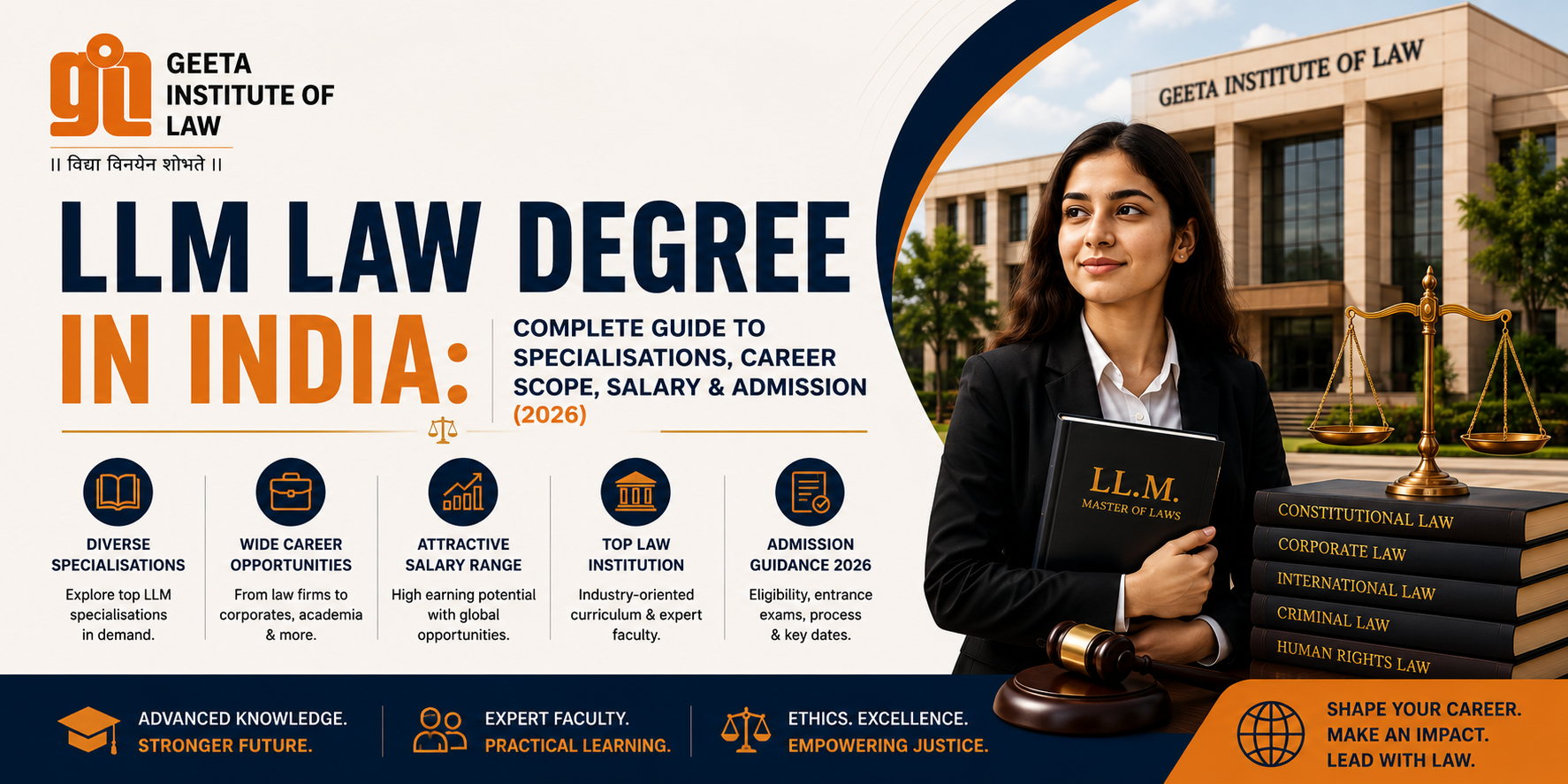
Everything law graduates need to know before pursuing a Master of Laws — and how to choose the right college.
An LLM law degree is a postgraduate Master of Laws qualification that lets law graduates specialise in a focused branch of law, sharpen their legal research skills, and unlock senior, better-paid roles across litigation, corporate practice, academia, and policy. If you have completed your LL.B. or a five-year integrated law programme and are wondering whether advanced study is your right next move, this complete 2026 guide walks you through everything — from LLM specialisations and LLM eligibility to career after LLM, salary expectations, and how to pick the right college. Whether you want to become a corporate counsel, a litigator, a judge, or a law professor, the right LLM course can be the single most powerful step you take toward a standout legal career. Over the past decade, specialisation has become the clearest way for lawyers to stand out, and a Master of Laws is the most direct route to it.
What Is an LLM Law Degree?
The Master of Laws, written as LL.M., is an advanced postgraduate degree pursued after a bachelor’s degree in law. While an LL.B. gives you broad, foundational training, an LLM lets you go deep into one or two specialised areas — such as corporate law, intellectual property rights, constitutional law, or international law — and build genuine subject-matter expertise.
An LLM course is far more research-intensive than an undergraduate programme. Students engage with case law, statutory interpretation, comparative legal systems, and a substantial dissertation, working closely with experienced faculty. This blend of specialisation and rigorous legal research is exactly what employers, courts, and universities look for when hiring for senior positions. In short, the degree signals that you are not just a lawyer, but a specialist. Crucially, an LLM degree also builds the analytical writing and advocacy skills that translate directly into courtroom and boardroom performance.
In India, a Master of Laws is typically offered as a one-year or two-year programme governed by university and regulatory norms. The two-year format remains the most widely recognised and is the structure offered by established institutions such as Geeta Institute of Law.
What Are the Eligibility Criteria and Admission Process for an LLM?
LLM admission in India is more accessible than many students assume, and the LLM eligibility criteria are straightforward. You generally need:
- A completed LL.B. (three-year) or a five-year integrated law degree such as BA LL.B. or BBA LL.B.
- A minimum aggregate score — commonly around 50 to 55 percent for the general category, with relaxation for reserved categories.
- A valid entrance test score where the institution or state requires one.
Admission to many top programmes is through entrance examinations such as CLAT PG (the postgraduate Common Law Admission Test) or university-specific tests, while some colleges also offer merit-based admission. For example, at Geeta Institute of Law, the LLM (2 years) requires an LL.B. or a five-year integrated law degree with 55 percent marks in aggregate for the general category, and minimum passing marks for SC/ST candidates.
Once you meet the LLM eligibility requirements, the LLM admission journey usually involves submitting an application, appearing for the relevant entrance test or counselling, and completing document verification and fee payment. Strong applicants also prepare a clear statement of purpose explaining why they want to specialise.
One-Year vs Two-Year LLM: Which Format Should You Choose?
One of the first decisions you will face is the duration of your LLM course. Both formats lead to a Master of Laws qualification, but they suit different goals. The table below compares them side by side.
| Factor | One-Year LLM | Two-Year LLM |
|---|---|---|
| Duration | 1 year (2 semesters) | 2 years (4 semesters) |
| Best suited for | Working professionals wanting a quick specialisation | Students wanting deeper research and a stronger base |
| Depth of study | Condensed and fast-paced | Broader coverage with more electives |
| Research & dissertation | Limited | Extensive, with a substantial dissertation |
| Value for academia | Varies by institution | Widely recognised for teaching and PhD pathways |
| Offered at GIL | — | Yes (LL.M. 2 years) |
For most students who want maximum flexibility, the widest recognition, and a solid foundation for a PhD or a teaching career, the two-year LLM is the safer, more versatile choice. It also gives you more time for internships, moot court practice, and a dissertation that can become a genuine portfolio piece.
What Are the Top LLM Specialisations in 2026?
Choosing the right specialisation is the most important decision of your LLM journey, because it shapes your entire career. As industries digitise and cross-border transactions grow, demand for specialised legal experts is rising sharply. Here are the most in-demand LLM specialisations and where they can take you.
| Specialisation | What You Study | Where It Leads |
|---|---|---|
| Corporate & Commercial Law | Mergers, company law, contracts, governance | In-house counsel, law firms, compliance |
| Intellectual Property Rights | Patents, trademarks, copyright, tech transfer | IP firms, R&D, media & tech |
| Constitutional Law | Fundamental rights, governance, judicial review | Litigation, judiciary, policy, academia |
| Criminal Law | Penal codes, evidence, procedural law | Criminal litigation, prosecution, judiciary |
| International Law | Trade, human rights, treaties, disputes | Global bodies, MNCs, diplomacy |
| ADR & Arbitration | Mediation, conciliation, arbitration | Arbitration practice, corporate disputes |
| Cyber & Technology Law | Data protection, privacy, AI regulation | Tech firms, consulting, regulators |
| Taxation & Environmental Law | Direct/indirect tax, climate and ESG rules | Advisory firms, government, corporates |
These emerging areas — especially technology law, data protection, and arbitration — are where some of the fastest hiring growth in the legal sector is happening right now. If you are unsure which path to pick, choose a specialisation that aligns with both your interests and the sectors hiring most aggressively in your region.
What Are the Career Opportunities After an LLM Law Degree?
A well-chosen LLM dramatically widens your professional options. Because you graduate as a specialist, you become eligible for roles a general law graduate often cannot access. Employers increasingly screen for niche expertise, which is precisely what a Master of Laws signals on a CV. Common career paths include:
- Corporate Lawyer / In-House Counsel — advising companies on transactions, compliance, and risk.
- Legal Consultant / Advisor — offering specialised expertise to firms and businesses.
- Litigator / Advocate — practising in a focused area such as criminal, civil, or constitutional law.
- Judicial Services — preparing for judiciary examinations to become a judge.
- Legal Academician / Professor — teaching law and pursuing research, often alongside a PhD.
- Policy & Research Analyst — shaping legislation with think tanks, NGOs, and government bodies.
- Arbitrator / Mediator — resolving disputes efficiently outside the courtroom.
Beyond these roles, a strong career after LLM also includes the option to clear the UGC-NET/JRF, pursue a PhD in law, and add significant weight to your CV when you compete for senior positions or international opportunities.
How Much Can You Earn After an LLM? Salary Guide
Earning potential is one of the biggest reasons students pursue an LLM, and a strong career after LLM is often defined by the salary jump that specialisation brings. While exact pay depends on your specialisation, employer, city, and experience, an LLM degree generally commands a premium over a basic law degree. The indicative ranges below reflect commonly reported LLM salary in India, so treat them as a guide rather than a guarantee.
| Role / Level | Experience | Indicative Salary (INR) |
|---|---|---|
| Junior Associate / Fresh Graduate | 0–2 years | Rs 4–7 LPA |
| Corporate / IP Lawyer | 2–5 years | Rs 7–12 LPA |
| Senior Associate / Specialist Counsel | 5–8 years | Rs 12–18 LPA |
| Legal Manager / In-House Counsel | 8+ years | Rs 18–30 LPA |
| Law Professor / Academician | Varies | Rs 6–15 LPA |
| Arbitration / International Law Expert | Senior | Rs 20 LPA and above |
Figures are indicative and vary with location, employer, and individual expertise.
Specialists in corporate law, intellectual property, and arbitration typically sit at the higher end of these ranges, especially in metropolitan markets and at top firms.
Is an LLM Law Degree Worth It?
For most ambitious law graduates, the answer is a clear yes. An LLM degree is worth it if you want to specialise, increase your earning potential, move into academia or research, or differentiate yourself in a crowded profession. It is especially valuable when you have a defined career goal — such as corporate practice, arbitration, or the judiciary — because the specialisation directly supports that path. In practice, a well-planned career after LLM rewards those who specialise early and deepen their expertise over time.
That said, the degree delivers the best return when you study at a recognised institution with strong faculty, practical training, and good placement support. The real worth of an LLM is not just the certificate; it is the depth of knowledge, the professional network, and the doors it opens. Choosing the right college, therefore, matters as much as choosing to do the degree at all. Think of it as an investment: the upfront time and fee are modest against a career of higher-value, specialised work.
How to Choose the Right College for Your LLM?
When you compare colleges, look beyond the brochure. The factors that genuinely affect your outcome include:
- Recognition and affiliation — confirm the college is affiliated to a reputed university and recognised by the Bar Council of India.
- Faculty quality — experienced professors and visiting practitioners make a real difference.
- Specialisations offered — check that your area of interest is available.
- Practical exposure — moot courts, internships, seminars, and research build job-ready skills.
- Infrastructure — a good law library, moot court hall, and digital resources matter.
- Placement and industry links — strong networks lead to better opportunities.
A college that scores well on these factors will give your LLM far more value in the job market — and picking the right LLM course at the right place is itself a career decision.
Why Choose Geeta Institute of Law (GIL) for Your LLM?
Geeta Institute of Law (GIL), located in Panipat, Haryana — within the Delhi NCR region — is one of the top-ranked law colleges in the area and a strong choice for your LLM law degree. GIL is recognised by the Bar Council of India and affiliated to Kurukshetra University, which holds a prestigious NAAC A++ accreditation.
The GIL two-year LLM (LL.M. 2 years) is designed to balance academic depth with practical exposure. Students benefit from experienced faculty, a dedicated moot court programme with national and international moot court competitions, research centres and journals, internships with leading legal firms, and modern infrastructure including a well-stocked law library and IT labs. The college’s strong industry connections and focus on real-world skills help graduates stand apart in a competitive profession. Many GIL students also gain exposure through guest lectures by judges and senior advocates, which sharpens both knowledge and professional networks.
GIL also makes quality legal education accessible through scholarships and the Geeta Law Admission Test (GLAT), with opportunities to earn up to 100 percent scholarship, and its LLM admission process is transparent and merit-friendly. If you want an LLM degree that combines recognition, mentorship, and career support, Geeta Institute of Law deserves a place at the top of your shortlist.
Start Your LLM Journey with Geeta Institute of Law
Ready to take the next step in your legal career? Explore the LLM (2 years) programme at Geeta Institute of Law and apply for the 2026–27 session today. With the right specialisation and the right college, your LLM law degree can open doors you never imagined.
Apply Now Explore LLM (2 Years) Fee Structure & Scholarships
Frequently Asked Questions
An LLM (Master of Laws) is a postgraduate degree pursued after an LL.B. or an integrated law degree. It lets you specialise in a chosen branch of law and build advanced legal research skills that general law graduates do not have.
You typically need an LL.B. or a five-year integrated law degree with roughly 50 to 55 percent marks. At Geeta Institute of Law, the LLM (2 years) requires 55 percent aggregate for the general category, with minimum passing marks for SC/ST candidates. These LLM eligibility norms are broadly consistent across most Indian universities.
An LLM course is offered as a one-year or a two-year programme. The two-year format, such as the LL.M. (2 years) at GIL, is the most widely recognised and offers deeper specialisation and a full dissertation.
The best choice depends on your career goal. Corporate law, intellectual property rights, international law, arbitration, and cyber law are among the most in-demand LLM specialisations in 2026.
Graduates work as corporate counsel, litigators, judges, professors, and arbitrators. Salaries in India commonly range from about Rs 4 LPA for freshers to Rs 18 to 30 LPA or more for experienced specialists.
Yes. For students who want to specialise, earn more, enter academia, or stand out in the profession, an LLM offers strong long-term value, especially when earned from a recognised college.
Absolutely. An LLM is the standard pathway to the UGC-NET/JRF, a PhD in law, and a career in legal teaching and research.
GIL offers a BCI-recognised, Kurukshetra University-affiliated two-year LLM with experienced faculty, moot court training, internships, scholarships, and strong career support in the Delhi NCR region.
Related Blogs

What is Criminal Law in India: Admission 2026, Entrance Exams, Courses, Best Colleges, Career Options India & Abroad
Criminal Law is one of the best law specialization in India that deals with offences…

How Law Education Builds Confidence, Ethics & Critical Thinking
Law schooling offers a number of advantages that extend far beyond the courtroom. The Benefits of…

Master Of Law Through Legal Expertise In The Heart Of India
An LLM degree is regarded as an advanced academic tool that aids legal professionals to…
Best Government Law Colleges in Delhi After 12th
Students aiming for a successful legal career should choose the right law college after Class…

LLM vs PG Diploma in Law: Which is Better for Your Career?
After earning your bachelor’s degree, you can pursue both a PG Diploma and an LLM….
Detailed List of NLUs in India 2026
The Consortium of NLUs in India represents the pinnacle of legal education, known for its…