
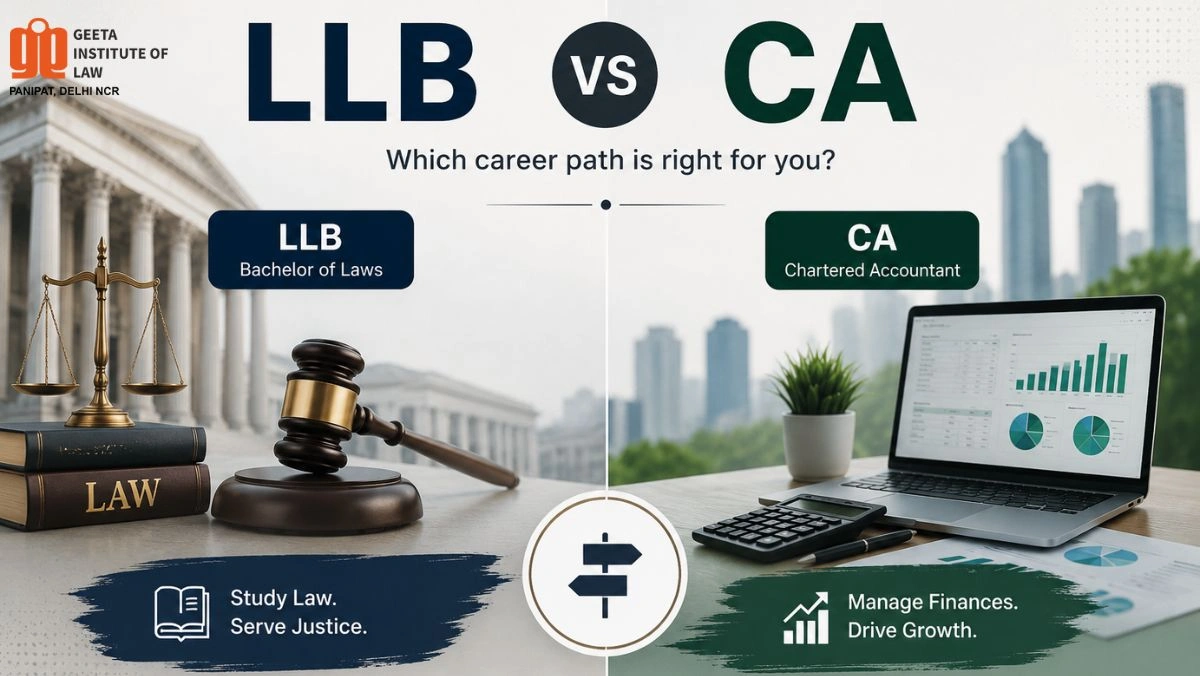
Students with a commerce background in 12th often get confused about whether to pursue an LLB 3 year course or become a CA. Both jobs are rewarding in their own domain. While CA focuses on finance and accounting, the LLB vs CA comparison shows commerce and legal experience, which is increasingly sought after in the corporate world.
LLB vs CA: Key Differences
Choosing between LLB and CA depends on whether you find yourself interested in analysing statutes or financial statements.
Core focus
- LLB: The focus is on law, justice, and advocacy. Students are required to have critical thinking abilities, research skills, and analysis of various constitutional, civil, or criminal laws in order to defend clients or provide sound legal advice.
- CA: This course focuses on financial matters, financial reporting, auditing, and taxation. The main objective here is to maintain the integrity of finances as well as accountancy in business affairs.
Course structure & duration
- LLB: Either a 3-year postgraduate or a 5-year integrated program that comprises semesters and periods of internship.
- CA: Lasts for 4.5-5 years of intense preparation, includes three levels of exams (foundation, intermediate, and final) plus mandatory 2-year articleship under the ICAI new scheme 2026. B.Com graduates can either pursue a 3-year LLB or directly register for CA Final, making both paths accessible after graduation.
Law or CA After 12th — Which Should You Choose?
Choosing between law or CA after 12th should primarily depend on the student’s preferences. An integrated BA LLB would suit individuals who have good communication skills, and desire to work either in courtrooms or corporate law. On the other hand, CA after graduation requires passing three levels of exams that requires financial abilities.
People Also Read: AIBE Syllabus: Subject-wise Breakdown, Exam Pattern & Registration Guide
BA LLB vs CA
| Feature | BA LLB (Integrated Law) | Chartered Accountancy (CA) |
| Duration | 5 Years (Fixed) | 4.5 to 5 Years (Variable) |
| Entry | Entrance Exams (CLAT, LSAT, GLAT, etc.) | ICAI Foundation Route |
| Curriculum | Humanities + Law Subjects | Accounting, Audit, Tax, Finance |
| Training | Periodic Internships | 2-Year Mandatory Articleship |
| Practice | Bar Council Enrollment | ICAI Membership |
BBA LLB vs CA
| Feature | BBA LLB (Integrated Law) | Chartered Accountancy (CA) |
| Duration | 5 Years (Fixed) | 4.5 to 5 Years (Variable) |
| Entry Route | Entrance Exams (CLAT, LSAT, ILICAT etc.) | ICAI Foundation Route |
| Curriculum | Business Management + Law Subjects | Accounting, Audit, Tax, Finance |
| Training | Periodic Internships + Moot Courts | 2-Year Mandatory Articleship |
| Practice License | Bar Council Enrollment + Bar Exam | ICAI Membership |
| Starting Salary | ₹6–18 LPA (varies by litigation/corporate) | ₹8–13 LPA (consistent) |
LLB vs CA: Which is Harder?
There is a group-wise passing system in ICAI, which makes CA comparatively more difficult than LLB as even one subject failure nullifies the entire group. With pass percentages of 5–10% at the Final level and a compulsory 2-year articleship simultaneously preparation for the exam, CA requires tremendous perseverance and numerical accuracy. Students take an average of 5-7 years to finish the qualification.
While, LLB though much simpler to clear, needs a lot of interpretation of ever changing acts and case laws. Moreover, graduates need to clear the All India Bar Examination (AIBE) conducted by BCI in order to practice legally.
CA Exam Difficulty (Foundation → Final)
From the beginning to the end, the CA Exam is designed to make candidates extremely focused. While at the Foundation level you learn basics, the Intermediate and Final levels demand perfection in advanced concepts related to taxes and audits. The major problem with these exams is the necessity to pass the whole group of subjects simultaneously.
LLB Difficulty & Bar Preparation
LLB’s biggest challenge lies in the constant interpretation of ever-changing statutes as well as cases. LLB demands extensive knowledge about the existing laws and logical interpretation skills. In addition, after LLB graduation or even before completion (as per the new BCI Rules in 2026), the candidate needs to pass the Bar Examination to prove his/her competence in practice.
CA vs LLB Salary in India (2026)
According to ICAI placement reports and law firm HR surveys (2025–26):-
LLB Salary: Entry to Senior Level
- Entry Level: ₹3 to 6 LPA (General); ₹10–18 LPA (Tier-1 Firms).
- Mid-Level: ₹15 to 30 LPA (Senior Associates).
- Senior Level: ₹40 LPA+ (Partners/Senior Advocates).
CA Salary: Fresher to Partner Level
- Fresher: ₹8 to 13 LPA average; Rank holders can reach ₹25 LPA+.
- Mid-Career: ₹15 to 35 LPA (Finance Managers).
- Partner Level: ₹50 LPA to ₹2 Cr+ (Profit-sharing).
Career Opportunities After CA
Chartered accountants play an essential part in the financial sector and work in a multitude of areas, transforming challenging figures into successful organisations.
- Big 4 Consultancies and Corporate Finance: Auditing and consulting in Deloitte, Ernst and Young (EY), KPMG, or PricewaterhouseCoopers (PwC), company financing.
- Taxation and Investment Banking: Taxation and GST management, and managing public offerings (IPOs) and valuation services for high-net-worth individuals.
Career Opportunities After Law
Opponents of all kinds of criminal proceedings and business have realised that many career options in law offer varied job roles like court based litigation to strategic corporate functions undertaken by MNCs.
- Litigation, Corporate Law, and Judiciary: Litigating, Corporates Mergers Acquisitions or Serving as Judge or Magistrate.
- In-house Legal Organisation and Law Firms: Act as legal advisor to an organization or work for specialized area of law.
Is Law Better Than CA in India?
The answer to this question lies in your preference for either the power of words or the precision of numbers; in any case, both are equally prestigious degrees. Thus:
Select LLB if you…
- Have excellent skills in communication, debating, and logical reasoning.
- Enjoy prolonged sessions of reading and interpreting statutes.
- Want to explore a range of careers from litigation to corporate advisory to the judiciary.
Select CA if you…
- Have high mathematical aptitude.
- Have sufficient discipline to sit through long hours of examinations and technical training.
- Are aiming for leadership positions in areas such as taxation, finance, or corporate advisory.
Conclusion
When comparing LLB vs CA programs, taking up a course in law is relatively popular among students who seek rapid progress and versatility in their careers. This combination of law and commerce results in making one highly valuable in the corporate environment. On the contrary, pursuing CA is perfect for a career in finance but requires a much harder grind.
Frequently Asked Questions
Although in terms of difficulty, CA is slightly tougher as it follows an group-wise marking method though LLB demands intense reading of the law case, CA requires extreme accuracy in calculations and sheer perseverance to complete two years of articleship simultaneously with exams.
Yes, numerous students have pursued both CA and LLB side by side. Such a combination is highly valuable for corporate law; it is valued by top law firms as well as Big Four consultants.
Starting packages of CAs are relatively more consistent, ranging anywhere from ₹8 LPA to ₹13 LPA on average. Whereas LLB offers salaries for litigation lawyers are lower (₹3 LPA to ₹6 LPA), corporate lawyers earn way more (₹12 LPA to ₹18 LPA at the best firms) than CAs.
Although you can pursue a career in corporate law without being a CA. But being a CA would give you additional insights into Mergers & Acquisitions and Taxation.
For LLB after class 12th, you need an integrated program of either BA LLB or BBA LLB, which will take exactly five years of studies. Under the new CA rules of 2026, it takes about 4.5 to 5 years to become a CA.
Related Blogs

Your Wait is Over! HBSE 12th Result 2026 Released
The Board of School Education Haryana (BSEH) has officially released the HBSE 12th Result 2026…

BA LLB vs LLB vs LLM: Understanding the Differences & Career Opportunities
When students complete their schooling and decide to pursue a career in law, they face…

AILET 2026: Syllabus, Exam Pattern, Eligibility & Preparation Tips
AILET 2026 is a national level law esteemed entrance test carried out by the National…

What is Criminal Law in India: Admission 2026, Entrance Exams, Courses, Best Colleges, Career Options India & Abroad
Criminal Law is one of the best law specialization in India that deals with offences…

BBA LLB Course Details: Syllabus, Eligibility & Semester-Wise Subjects
Bachelor of Law and Business Administration (BBA LLB) is an undergraduate course, a five-year program,…

Importance Of Studying Law: Why GIL is a Top Choice
The study of law, duties and rights in order to train experts in the legal…