
How to Fund Your Law Degree in India: Loans, Government Schemes & Scholarships
Home / LAW / How to Fund Your Law Degree in India: Loans, Government Schemes & Scholarships
Funding the whole degree with an education loan for law students in India is easy now, with multiple options available. You can become a Supreme Court lawyer, work in business law, or in the judicial branch with a law degree, but only if you can afford to get there. For the majority of students in India, it is an education loan. Banks consider LLB and BA LLB degrees equivalent to engineering and MBA courses, and government schemes such as PM-Vidyalaxmi and CSIS have become helpful; no need for collateral, interest at subsidised rates, and a unified portal for applying.
How Much Does a Law Degree Actually Cost?
The fee of a law degree in India varies from a government college, private institution, or NLU. Here is an overview of law course fee structure:
| Course | Government College | Private College |
| LLB Course Fees (3 years) | ₹10,000-₹50,000/year | ₹1,00,000- ₹5,00,000/year |
| BA LLB Course Fees (5 years) | ₹10,000-₹50,000/year | ₹75,000-₹1,50,000/year |
| LLB fees in Delhi | ₹18,000-₹21,000/year (DU) | ₹1,92,000/year (avg.) |
Read More: List of NLUs in India 2026
Why Are Law Education Loans Easier Now?
Below are the government schemes for education loans for law students in India:
- PM-Vidyalaxmi (2024): One-stop solution providing interest-free education loan for law students in India via a centralised portal. There is a 3% interest subvention offered to families with an income between ₹4.5L and ₹8L.
- CSIS Scheme: 100% interest waiver during the course and for one additional year for students belonging to families whose annual income doesn’t exceed ₹4.5L.
- CGFSEL: Collateral-free education loans up to ₹7.5 lakh for higher studies in India/abroad.
- NMDFC Education Loan Scheme: Only for minority communities (Muslim, Christian, Sikh, Buddhist, Parsi, Jain) with an income of < ₹3 lakh to 8 lakh. Offers low-interest loans (3%) for courses in India/abroad.
- NBCFDC Educational Loans: Provides education loans at low interest (3.5%–4%) for students from backward classes.
- NHFDC Concessional Loan for Students with Disabilities (40% & above): Loans of up to ₹50 lakh at concessional rates.
- NSFDC Loan Scheme: For Scheduled Castes (SC), whose annual family income is less than ₹5 lakh.
- Pragati Scholarship Scheme: A scholarship scheme for girls studying technical education.
- Central Sector Scheme of Scholarships: Financial assistance at ug/pg levels. 20,000 scholarships for technical/professional courses every year.
Banks Offering Education Loans
| Bank | Max Loan (India) | Interest Rate (p.a.) | Collateral-Free Up To |
| SBI | ₹20 lakhs | 9.5%-11.5% | ₹7.5 lakhs |
| Bank of Baroda | ₹20 lakhs | 9.40%-11.25% | ₹7.5 lakhs |
| PNB | ₹20 lakhs | 9.40% onwards (EBLR linked) | ₹7.5 lakhs |
| Canara Bank | ₹20 lakhs | 9.45%-11.15% | ₹7.5 lakhs |
| Credila (NBFC) | Customised | 11%-13% | Flexible |
Earlier, the Canara Bank acted as the nodal bank; the majority of the subsidy allocation process has been moved to the central PM-Vidyalaxmi portal. You can apply to these banks through the portal, which will check your subsidy eligibility for you.
Eligibility: What Banks Actually Check
The education loan for law students in India requires:
- An Indian citizen between 18 and 35 years old. It may stretch to 40-45 years for working professionals pursuing higher studies.
- Confirmed admission at a BCI-approved and university-affiliated law college
- Minimum 50% marks scored in the last qualifying exam
- Co-applicant (parents/guardians) having a stable and verifiable income
- A good CIBIL score for your co-applicant to get your loan sanctioned faster
Education loans for law students in India that exceed ₹7.5 lakhs require physical assets like immovable properties, fixed deposits, or even securities as a guarantee.
What Does the Loan Cover?
Banks provide an education loan for law students in India covering:
- College tuition fee
- Accommodation expenses
- Textbooks and other study materials, including a laptop (required for your studies)
- Exam fee
How to Apply: Step by Step
Step #1. First of all, get your admission letter.
Step #2. Visit Vidyalaxmi.co.in to apply to multiple banks with a single application form.
Step #3. Upload the following documentation:
- Academic: 10th & 12th marks certificates + Graduation marks certificates for a 3-year LLB course.
- Admission: Official admission letter along with the complete course fee schedule.
- Your KYC and Financial details: Aadhaar, PAN card, and a 6-month statement of both the applicant and the cosigner.
- Income Certification: For CSIS and PM-Vidyalaxmi subsidies, you need to have a government income certificate issued by the Tehsildar/SDO. Note that affidavits or IT Returns won’t do the trick here.
Step #4. Bank appraisal and a sanction letter. The bank disburses the loan amount directly to your institution.
It takes about 15-30 days for SBI’s Student Loan to be processed. Be sure to also apply for an interest subsidy at the PM-Vidyalaxmi portal in one go.
Section 80E tip: The benefit starts from the financial year in which loan repayment begins. Interest on education loan for law students in India can be deducted from taxable income fully for 8 consecutive years, but only under the Old Tax Regime. Only the interest amount is deductible, not the principal amount. Under the new tax regime introduced from 2026 onwards, this is no longer possible. But it offers tax breaks till ₹12 lakhs, so opt in to the Old Regime to use Section 80E.
Pro-Tip: Apply to the Vidyalaxmi portal and opt for the PM-Vidyalaxmi scheme benefits while applying.
Repayment: What to Expect
The moratorium period equals your course duration plus 12 months (so, you won’t need to repay anything until the period is finished). Usually, the repayment period lasts for 15 years at most public banks, but there’s no pre-payment penalty at SBI.
Tip: Always try to pay interest alone during your studies rather than making EMIs.
Must Read:
Scholarships for law students in India
Government Scholarship Programs
- Central Sector Scheme of Scholarship (CSSS) — part of the Pradhan Mantri Uchchatar Shiksha Protsahan (PM-USP) scheme for professional course students
- Post-Matric Scholarship — BCI-recognized colleges for SC, ST and OBC students
- Apply at: scholarships.gov.in
State Government Scholarships
- Students in Haryana will be able to avail the Haryana State Merit Scholarship and Dr.Ambedkar Medhavi Chattar Yojana
- Scholarships for minority communities
- Pre/Post-Matric Minority Scholarship under Ministry of Minority Affairs
- NMDFC loan at subsidised rates for 6 minority groups
Private law college scholarships
- Based on Class 12th percentage, Merit scholarships
- Sports quota for national-level and state athletes
- Girl students and families with a defence background have special grants
Conclusion
Education loan for law students in India is offered only when they join a BCI-approved and university-affiliated college.
If you’re trying to find an affordable private law college in India, Geeta Institute of Law in Panipat, Haryana offers better loans and scholarships for students enrolling in undergraduate or postgraduate courses. For students searching for low-fee law colleges in Delhi NCR, that combination of accreditation and affordability makes the admission process considerably simpler.
Check out the admission registration process to get into the law colleges in India.
Frequently Asked Questions
Yes, LLB and BA LLB course fees are covered under the IBA Model education loan for law students in India Scheme.
SBI's Student Loan Scheme covers up to ₹20 lakhs. PM-Vidyalaxmi offers a maximum of ₹7.5 lakhs without requiring collateral and up to ₹10 lakhs for 3% interest subvention. Non-banking institutions may lend up to a higher amount depending on your financial standing.
No, under the Credit Guarantee Fund Scheme for Education Loans (CGFSEL), you don't need collateral or a third-party guarantee to secure a loan of up to ₹ 7.5 lakhs.
Yes, CSIS offers an interest-free loan for the entire study period to families with an annual income not exceeding ₹4.5 lakhs.
Related Blogs

Masters of Law Programs in India: The Complete 2026 Guide to the LLM Law Degree
Masters of law programs in India are postgraduate LLM (Master of Laws) degrees that you…

Private vs Government Law Colleges in India: Which Is Better?
Choosing one of the best law colleges is a very important choice for a student…
Haryana Judiciary Exam 2026: Syllabus, Eligibility, Exam Pattern & Preparation Tips
Haryana Judiciary Exam 2026 is a competitive state-level recruitment exam that selects law graduates for…
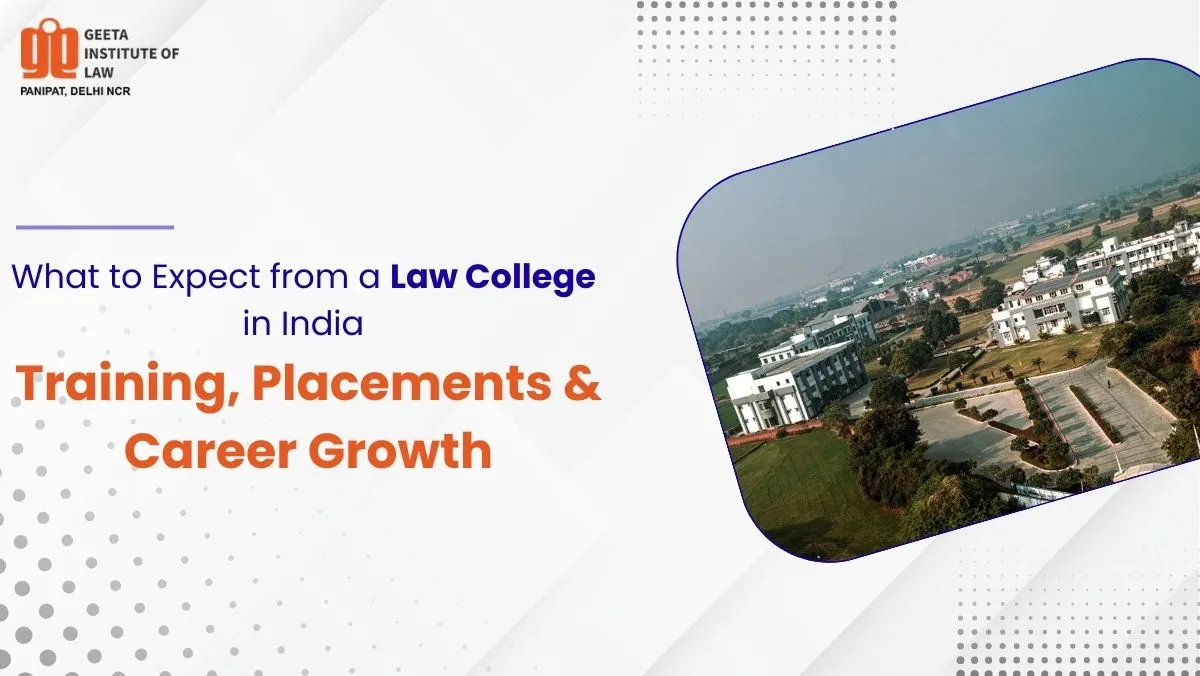
What to Expect from a Law College in India: Training, Placements & Career Growth
India’s law institutes have significantly evolved over the years. Students nowadays want more than just…

What is International Trade Law in India?
Trade between two or more nations is covered under the area of law, International Trade…
Best Government Law Colleges in Delhi After 12th
Students aiming for a successful legal career should choose the right law college after Class…