
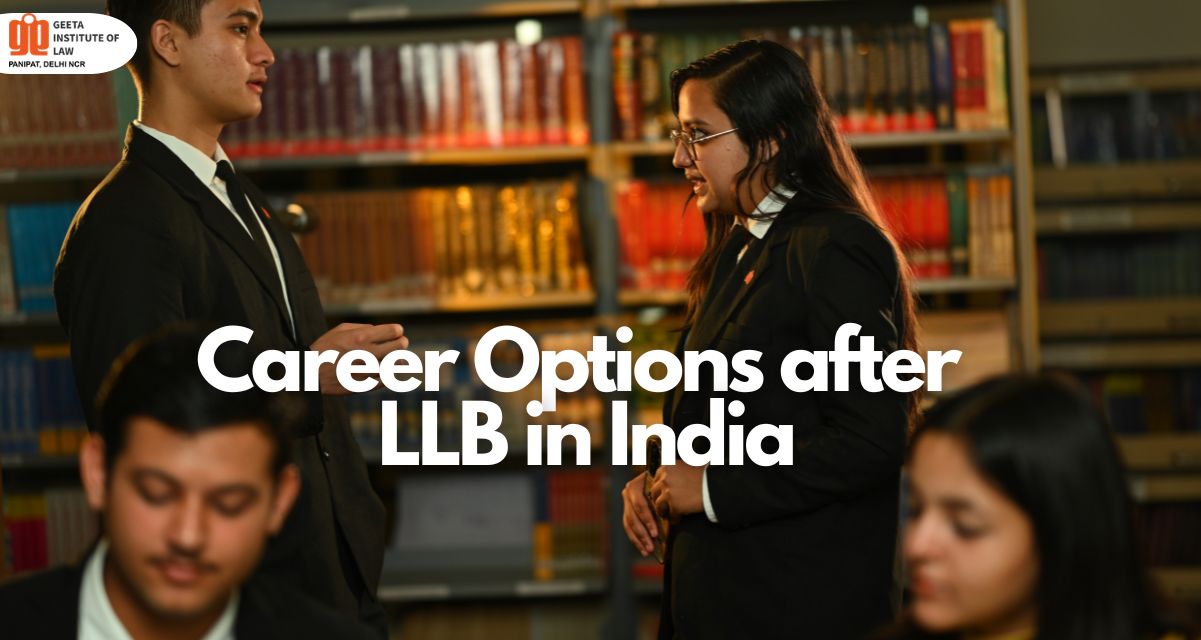
Bachelor of Laws (LLB) is a law graduate degree, a professional course, which students can take to establish a good legal career. The course is done in three years after graduation and covers six semesters. It comprises fundamental legal courses and an internship, moot court, drafting, and court training.
LLB 3 year course that specializes in legal principles, the constitution, laws about corporations, and the judicial process. Having graduated in India, the graduates can pursue different career options after LLB, like in litigation, corporate firms, the judiciary, government departments, and legal consultancy.
Career options after LLB in India
Having an LLB degree, the graduates can pursue a career in litigation, corporate law, judiciary, legal consultancy, academics, media, and the service of the government. The discipline provides both government and non-government jobs with specialization, skills, and experience, which are attained during the course.
- Litigation Lawyer
After the three years of study of the LLB course, students can practice in either the district courts, the High Courts, or the Supreme Court. The initial years will be based on internship and employment in the chambers of the senior advocates. Being an expert and well-established practitioner, my income and personal practice have increased significantly.
- Corporate Lawyer
The 3-year LLB course allows graduates to work in firms that deal with contracts, mergers, compliance, and legal documents. Business hubs of Delhi NCR, such as Gurugram and Noida, also have corporate law, which provides the structuring of salaries and stable growth.
- Judicial Services
PCS(J) exams can be prepared by students once the LLB 3 year course is completed. Passing the judge exams will enable them to be civil judges or magistrates. This is a good high responsibility and stable government career option.
- Legal Advisor
Firms, banks, and startups recruit legal advisors following the three-year LLB graduate program to address disputes, contracts, and regulatory mandates. This is a stable position with corporate exposure.
- Public Prosecutor
Upon the attainment of experience after a three-year post-LLB course, it is possible to be employed as a public prosecutor, whereby the person is employed by the government to prosecute criminal cases on its behalf. This position needs good courtroom and legal training skills.
- Legal Journalist
Recipients of the three year LLB course may become legal journalists who write about the judgments of the courts, their policies, and constitutional issues. Law graduates are employed in media houses and legal portals.
- Academician (After LLM)
Students have the opportunity to take the LLM program once they have completed a LLB 3 year course and become lecturers or professors in law colleges. This profession is ideal in the case of research and teaching.
- Legal Consultant
Law consultants practice alone on taxation, compliance, and corporate issues, having completed the 3-year LLB course. Consultancy provides lucrative earnings.
- NGO & Human Rights Lawyer
Three years following the LLB course, students are able to work in NGOs that deal with human rights, environmental law, and social justice as part of the social development.
- Arbitration and Mediation Expert.
Students have multiple career options after LLB, one of them is specialists, thus being able to work in the area of arbitration and dispute resolution, which is fast emerging in India business world.
Top Colleges to Do LLB Courses in Delhi NCR
With the pace of change in the technology-oriented legal profession accelerating, those studying law today are not only getting ready for courtrooms but also for careers in cyber law, data security, corporate compliance, and digital governance.
Here are some of the institutes that have utmost importance in a LLB 3 year course, with practical exposure and industry-ready skill sets:
- University of Delhi, Faculty of Law—Delhi.
- Amity Law School – Noida
- ICFAI Law School – Gurugram
- CPJ College of Higher Studies & School of Law—Narela, Delhi.
- Lloyd Law College, Greater Noida.
Additionally, emerging private institutions such as Geeta Institute of Law are also contributing to legal education in the NCR region by offering many career options after LLB, practical exposure, and skill development initiatives to support students in building successful careers in the modern legal landscape.
Admission Process
The 3-year LLB course is usually admitted to via:
- CLAT PG (in certain private universities)
- University-level entrance examination, i.e., CUET.
- Direct entry (in private colleges based on merit)
Students are taken through the clearance, counseling, and verification of documents to be finally enrolled in the LLB 3 year course after clearing the entrance.
Explanation of the 3-Year LLB Syllabus
The LLB degree is a 3-Year Course in law, on a 6-semester basis. The curriculum combines the main legal studies with practical elements such as internship, moot court, drafting, and court exposure, making sure that the students are professionally ready to litigate, work in corporations, and become judges.
Below is the syllabus of the LLB 3 year course explained in a broad and simplified manner:
Here’s the LLB 1st-year syllabus
- Law of Contract
- Law of Torts
- Constitutional Law
- Family Law
Here’s the LLB 2nd-year syllabus
- Criminal Law (IPC, CrPC)
- Property Law
- Company Law
- Public International Law
Here’s the LLB 3rd-year syllabus
- Civil Procedure Code (CPC)
- Administrative Law
- Labour Law
- Drafting & Pleading
- Professional Ethics
The 3-year LLB course includes moot courts, internships, and court visits under the LLB 3 year course syllabus for practical experience.
Graduates can advance their studies after the LLB.
Most graduates of the three year LLB course pursue further education or professional qualifications after graduation in order to enhance their professional knowledge and increase employment opportunities. High qualifications not only add knowledge but also boost specialization in the law profession.
Here is a look at some of the career options after LLB in India:
- Master of Laws (LLM)
Master of Laws (LLM) is a graduate degree in which one can major in a specific area of law. It suits the students who are academically or research-oriented, policy-making, judiciary preparation, or high-level corporate job-oriented.
Key Specializations:
- Corporate Law—Concentrates on mergers, acquisitions, compliance, and company regulations.
- Criminal Law—Research of second degree criminal justice system and litigation.
- International Law—International treaties, international trade law, and international relations.
- Human Rights Law involves civil freedoms and constitutional rights.
- Intellectual Property Rights (IPR)—Coverage of patents, copyrights, and trademarks.
- Constitutional and Administrative Law—Enriches the knowledge of governance and public law.
A degree in LLM may also provide access to a teaching and PhD program after just completing the LLB 3 year course.
- MBA After LLB
Other graduates are getting an MBA in business management, HR, or finance. This combination is much appreciated in corporate sectors, compliance units, and the management functions within multinational companies.
- Preparation of Judicial Services.
One of the best career options after LLB is getting selected in the government sector. The majority of students at law schools go through examinations as judges in states following the LLB. Acquiring these exams will allow them to qualify as civil judges or magistrates, and this will give them a stable and prestigious career in the government.
- Professional Certification Courses
- Short-Term Certifications enhance hands-on knowledge and specialization:
- Cyber Law Certification—Specializes in cyber crimes and information security.
- Corporate Compliance Course—This is an overview of regulatory frameworks and governance.
- Arbitration & Mediation Certification equips individuals to work in alternative dispute resolution.
- Course in Taxation—deals with GST, income tax, and corporate taxation.
- Legal Drafting and Contract Management—Develops enhanced proficiency in documentation.
After LLB Salary in India
After completing a three-year course, students can choose any career options after LLB based on their interests and specialization. The salary they earn largely depends on the profession they enter, their level of experience, skills, and the organization they work with.
- Freshers’ Salary
- Litigation beginners: ₹3–5 LPA
- Entry-level positions in the corporate sector: 5-8 LPA.
- The best law firms: ₹12–18 LPA (in the case of outstanding candidates)
- Experienced Professionals
- 5–10 years experience: ₹8–15 LPA
- Senior advocates or corporate counsels: 20 LPA or above.
- Judges and government officials: Organized remuneration according to government scales.
Graduate education and post-LLB qualifications have a positive impact on future earning capability and career development.
Conclusion
The LLB 3 year course is a great choice for those who have chosen to pursue a professional and valued career in law. Students can pursue multiple career options after LLB. Delhi NCR offers good opportunities to students, who develop exposure to courts and business contacts. The process of selecting an appropriate college to boost practical learning, internship, and long-term career development within the legal sector.
Frequently Asked Questions
It is a 3 year under degree program which is made up of 6 semesters.
They are high school graduates who have graduated from any accredited university with minimum qualifications.
It includes constitutional law, criminal law, CPC, administrative law, drafting, internships, and moot courts.
Yes, then you can pass the state exams in judicial service by passing the course.
These are litigation, corporate law, judiciary, legal advisor, consultancy, academics, and the public service.
Related Blogs

LLB 3 Year Course of Law: Syllabus, Exam Pattern & Admission 2026
The choice of pursuing law as a profession following graduation is an important choice. With…

BA LLB vs LLB vs LLM: Understanding the Differences & Career Opportunities
When students complete their schooling and decide to pursue a career in law, they face…

How to Prepare for Judiciary Exams While Studying in 3 Year LLB Colleges in Delhi
The preparation for judiciary exams during a 3 year LLB colleges in Delhi incorporates core…