
When students complete their schooling and decide to pursue a career in law, they face many questions. Should they pursue BA LLB or LLB after 12th? What are the best law courses after 12th? What is LLM, and is it worth enrolling in it post LLB? Post the introduction of five-year integrated programmes in India, along with the mushrooming of National Law Universities, this confusion often grips legal aspirants before they embark on their legal education journeys.
The Bar Council of India (BCI) is the statutory body that governs legal education in India and grants approval to law colleges, universities, and their courses. Its recognition is a testament to the fact that the course fulfils the professional standards, and the graduates can practice the law.
This article addresses all these questions, attempting to solve the confusion in the simplest way possible.
The Three Degrees: Basic Framework
The Three Degrees is a set of principles that explains the hierarchical nature of legal education, encouraging students to reflect on their own progress. Each tier is incremental, leading would-be lawyers through the basics to more complex levels of knowledge. This framework brings clarity to students when selecting the right law courses and building a winning career in law.
BA LLB / BBA LLB
BA LLB / BBA LLB are five-year integrated undergraduate programmes that students can enrol in directly after passing out from school. As indicated by their names, they combine a Bachelor of Arts, Business Administration or Commerce with Bachelor of Laws. Students therefore study subjects such as political science, history or management along with law subjects from the first year itself.
The five-year integrated course is spread across ten semesters. The first two to three years include non-law subjects with foundational law courses. The BA LLB students, for instance, study subjects such as Political Science, History, Economics, and Sociology, while the students pursuing BBA LLB study Management and Business Studies.
Further, from the third year, the curriculum focuses on core law subjects, along with practical subjects such as drafting, pleading, and professional ethics to prepare young students for life after law school.
Also Read: BA LL.B vs BBA LL.B: Which Law Course Is Right After 12th
LLB
LLB is a three-year law degree that legal aspirants can pursue after completing their bachelor’s degree. This used to be the only pathway to become a lawyer in India up until the early 2000s. To be eligible for the course, candidates require a bachelor’s degree in any discipline. Various state as well as central universities such as the Delhi University and Banaras Hindu University offer the three-year LLB degree program.
LLB after graduation is the best pathway for aspirants who wish to switch career paths and discover their calling in law later. Further, the focussed curriculum allows the candidates to complete their legal education quickly and enter the legal profession at a stage where they have already experienced diverse pathways and have attained a distinct level of maturity.
LLM
LLM or Master of Laws is a postgraduate degree that students can pursue to gain specialised knowledge in their preferred subject area. Its duration can be one to two years. Popular specializations including Criminal Law, Constitutional Law, International Law, IPR and Taxation are in high demand.
In India, NLUs and private universities such as Symbiosis and Jindal Global Law School, are some of the top institutions offering LLM. Further, students are also increasingly choosing to pursue the degree from foreign universities such as Harvard, Oxford, Cambridge and LSE.
Career Opportunities: Is One Better than the Other?
Both BA LLB and LLB graduates who wish to enter litigation appear for the same All India Bar Examination (AIBE) to secure their practicing license. Although top-tier law firms recruit many candidates from NLUs which offer the five-year integrated course, many LLB graduates from traditional universities with strong internship records make it to these firms as well. Further, judicial aspirants too, come from both pathways, and the opportunity to succeed is immense for all.
So, when students wonder if one course is better than the other; the short answer is no. The five-year integrated course does save a student one year. It is perfect for students who are 100% sure that they wish to pursue law after 12th standard. Others, who are sill not sure, must for the 3-year traditional degree path.
Is LLM worth it?
A decade ago, LLM was considered mandatory for the sole purpose of entering academia. However, things have evolved since. Corporate firms, particularly top-tier ones, now pay higher to candidates who have a degree from any leading foreign universities, NLUs and top LLMin India. Specialisations in IPR, International Law and Taxation are desirable qualifications for senior associate roles and nice practice teams, where subject expertise add significant value.
Further, if one wishes to teach law, UGC-NET along with LLM is a mandatory qualification in India. So, if one wishes to specialise deeply in a legal field or is aiming to join academia or law firms, LLM must be pursued.
Know About: What Does an LLM Degree Stand For?
Law at Geeta Institute of Law
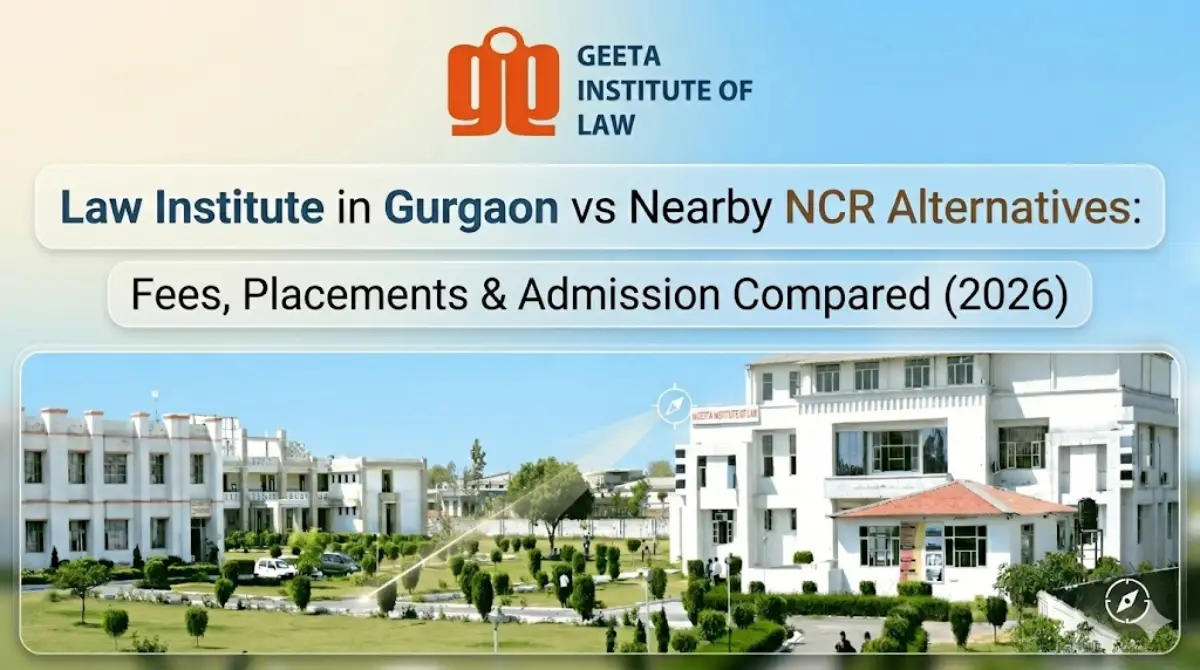
Geeta Institute of Law provides the option to pursue BA LLB, BBA LLB and also a three-year LLB program for those with a graduation degree in another field. It also has a rigorous LLM degree program to further give specialising opportunities to law graduates.
Moreover, it is among the best BA LLB colleges in Delhi, offering various internship opportunities for students at Geeta, along with the opportunity to participate in moot court competitions that provide practical exposure to future lawyers. So no matter which degree one chooses, students are prepared to become fine legal professionals at the institute, with the necessary skills to thrive in the field.
Conclusion
To conclude, choosing whether to pursue a 3 year or a 5 year integrated program solely depends on an aspirant’s personal goals and long term clarity of purpose. While a 5-year degree gives you early entry in the legal field, a 3-year course is opted by students who have already pursued a bachelor’s degree in another field, and wish to switch careers. Lastly, an LLM degree is not mandatory, but it is a desirable degree for many specialised fields in law and also gives you global opportunities in the field.