
Three New Criminal Laws in India: BNS, BNSS & BSA Explained
Home / LAW / Three New Criminal Laws in India: BNS, BNSS & BSA Explained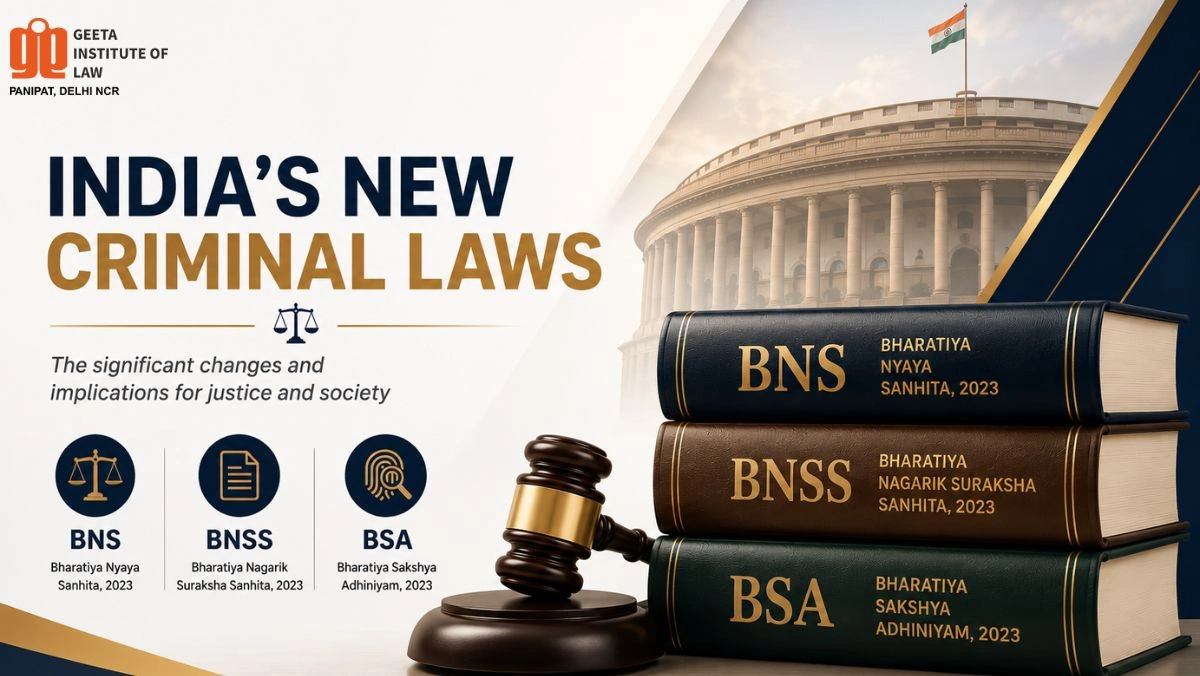
Legislative changes took effect on July 1, 2024, following the repeal of the old criminal laws. The three new criminal laws in India are the Bharatiya Nyaya Sanhita (BNS), the Bharatiya Nagarik Suraksha Sanhita (BNSS) and the Bharatiya Sakshya Adhiniyam (BSA), which have completely replaced three colonial-era legislations in India, namely the Indian Penal Code 1860, the Code of Criminal Procedure 1973 and the Indian Evidence Act 1872.
This was not a regular change. This was the biggest reform in the criminal law framework in India since Independence. If you are a BA LLB/BBA LLB/LLB student, a judiciary exam aspirant, or a UPSC Law optional aspirant, it is important to understand the new criminal laws in India.
What Are the Three New Criminal Laws in India?
The names of these new criminal laws in India are:
- BNS — Bharatiya Nyaya Sanhita, 2023 — replaces the Indian Penal Code, 1860
- BNSS — Bharatiya Nagarik Suraksha Sanhita, 2023 — replaces the Code of Criminal Procedure, 1973
- BSA — Bharatiya Sakshya Adhiniyam, 2023 — replaces the Indian Evidence Act, 1872
Together, these three laws completely rewrite how crimes are defined, how trials are conducted and how evidence is proved in every court across India.
When Did the Three New Criminal Laws in India Come Into Force?
The new criminal laws have the most crucial dates in modern legal history. The full legislative history follows:
- On August 11, 2023, the Home Minister introduced three bills in the Lok Sabha. On 11 August 2023, the Home Minister presented three Bills in the Lok Sabha.
- On 24 August 2023, the written communication was referred to the Parliamentary Standing Committee on Home Affairs.
- On November 6 and 10, 2023, the Committee reported (Report Nos. 246, 247, 248)
- On December 21, 2023, the bills were passed in Parliament.
- This has been assented to by the President and notified in the Gazette of India on the 25th of December, 2023.
- All three new criminal laws in India came into effect on July 1, 2024
Important for the students & practitioners: In cases/ FIRs registered before 1st July 2024, the old law will continue to apply. The new laws will only be in force for cases filed from July 1, 2024.
Who Drafted the New Criminal Laws in India?
It is a common question asked in UPSC and judiciary exams; hence, it needs to be answered clearly.
- Lord Thomas Babington Macaulay drafted the IPC through the First Law Commission, constituted in 1834 under the Charter Act of 1833.
- The draft was submitted in 1837, and the Code came into force in 1860. The new criminal laws were prepared by the Union Ministry of Home Affairs, which introduced all three bills in Lok Sabha on 11th August 2023.
- The bills were considered by the Parliamentary Standing Committee on Home Affairs, which sat 12 times and made recommendations in November 2023.
- The final versions were approved after incorporating the suggestions of the Committee on 21st December 2023.
- The reform has been introduced to achieve the “Panch Pran” objective — to eliminate all traces of colonial rule from governance systems in India.
Why Is IPC Replaced by BNS?
This is among the most sought questions for this topic and is frequently seen in UPSC mains, law semester papers and judicial service exams.
The Colonial Problem
When the IPC was written in 1860, several provisions were considered outdated for Indian citizens. That’s why new criminal laws came to address contemporary crimes such as organised crime, terrorism and cyber-enabled offences.
Key reasons the IPC was replaced:
- General criminal law did not provide any provisions with regard to terrorism and organised crime.
- The old language referred to things that are no longer there, such as the telegram office.
- There was no community service as punishment; only fines, imprisonment and death.
- In 2022, the Supreme Court kept Section 124A IPC (sedition) in abeyance, suspending all fresh proceedings pending constitutional review.
- No recognition of electronic evidence, e-FIRs or digital proceedings is accepted.No e-FIRs, digital Proceedings or e-Evidence accepted.
- People were having to wait for lengthy and time-consuming procedures for millions of cases to be filed.
BNS — Bharatiya Nyaya Sanhita 2023: Key Changes from IPC
What is BNS?
Bharatiya Nyaya Sanhita 2023 is one of the three new criminal laws in India, which enumerates crimes and prescribes punishments. BNS has 358 sections while IPC has 511 sections. The name itself is an indication of the change – Nyaya means justice, whereas the Penal Code was punishment-based.
Key changes under BNS:
- Section 113 BNS: Terrorism is defined for the first time in general criminal law (Section 113 BNS). Previously, terrorism was only defined under the UAPA. The BNS Section 113 is a new definition of terrorism in the general criminal law, which would apply to everyone, and without the protections of the UAPA.
- For the first time, there is an organised crime definition and a dedicated provision in the general criminal law (BNS 111).
- Section 124A IPC (Sedition): It has been replaced by Section 152 BNS, which introduces a new offence penalising acts that endanger the sovereignty, unity and integrity of India, with imprisonment up to life or a minimum of seven years plus fine. Under another name, it would be considered sedition by some.
- Section 4 BNS: Community service is incorporated in criminal law for the first time in India in six categories of minor offences (Section 4 BNS), which is a big step towards the rehabilitation concept.
BNS introduces a separate offence of snatching, recognising it independently from traditional theft and robbery.
The number of people imprisoned for 33 offences rose, with 20 new crimes recorded such as organised crime, terrorism and petty organised crime and acts against the state.
BNSS — Bharatiya Nagarik Suraksha Sanhita 2023: Key Changes from CrPC
What Is BNSS?
Bharatiya Nagarik Suraksha Sanhita 2023 is among three new criminal laws in India that regulates the investigation, trial and determination of cases from the filing of an FIR till the final appeal in India. There are 531 sections in BNSS, whereas CrPC has 484 sections.
The key changes to be expected under BNSS are set out below:
- The legalisation of Zero FIR (Section 173 BNSS): Any police station is bound to register any FIR irrespective of the location of the crime. It now has full statutory force, as opposed to being a Supreme Court direction.
- E-FIR: a game-changer for urban India for filing of FIRs electronically for certain of the offences.
- Trial in absentia (Section 356 BNSS): A gap in the law that has been filled by the courts to hold trials and make judgments when an accused is absent — a so-called ‘proclaimed offender’.
- Forensic investigation (Section 176 BNSS): For 7 years and above, a forensic team will be called to the scene of the crime. This is a required condition that seeks to enhance conviction rates based on scientific facts.
- A new important victim protection provision: 90-day update rule for Police to inform victims of progress of investigation.
- Video trials and electronic proceedings (Section 530 BNSS): All trials, inquiries, hearings and service of summons are now available to be conducted electronically, or with audio-video.
BSA — Bharatiya Sakshya Adhiniyam 2023: Key Changes from Indian Evidence Act
What Is BSA?
The Bharatiya Sakshya Adhiniyam 2023 comes under the three new criminal laws in India on the evidence that can be submitted in court and how it must be produced. The Evidence Act has 167 sections, while BSA has 170 sections. Its most important contribution is the use of electronic evidence as primary evidence, which reflects the way that modern crime is committed, investigated and proved.
Key Changes Under BSA:
- Admissibility of electronic records (Section 63): BSA expands recognition of electronic and digital records and streamlines their admissibility as evidence in judicial proceedings.
- Digital expert opinion recognised (under Section 39 BSA): The use of electronic and digital forensic experts is now available to provide expert opinion, recognising that investigations in today’s world need experts with a focus on cybercrime and digital forensics.
- Secondary evidence expanded (Section 58 BSA): Electronic copies and certified digital documents are added to the list of secondary evidence; testimony of document examiners who are knowledgeable in the field of digital authentication is added to the list of secondary evidence.
- Banker’s books updated: Unchanged, banker’s books are updated to include digital banking records, account statements in electronic format and logs of online transactions.
Please note that there are changes in the number of sections in the BSA, as compared to the Indian Evidence Act.
Three New Criminal Laws in India — UPSC Perspective
For students preparing for UPSC Civil Services with Law Optional or General Studies Paper II, the three new criminal laws in India 2024 are a central topic. Here are the facts every aspirant must know:
Prelims-relevant facts
- BNS — 358 sections (IPC had 511)
- BNSS — 531 sections (CrPC had 484)
- BSA — 170 sections (Evidence Act had 167)
- Effective date: July 1, 2024
- Presidential assent: December 25, 2023
- 20 new crimes added under BNS
- Imprisonment increased for 33 offences
- Community service introduced for 6 offences
Mains-relevant themes
- Decolonisation of India’s criminal justice system
- Shift from punishment-centric to justice-centric jurisprudence
- Technology and criminal law — electronic evidence, e-FIR, video trials
- Criticism — sedition by another name, expanded police custody, terrorism definition without safeguards
Importance of new criminal laws for law students & aspirants?
For BA LLB and BBA LLB Students
- In the semesters, the Criminal Law papers are focused on BNS, and not IPC.
- Nowadays, articles in Law of Evidence papers make reference to BSA Provisions.
- There are references to BNSS in Criminal Procedure papers, such as Zero FIR, forensic mandates, and trial timing.
For Aspirants of Judiciary Exam
- Haryana Judicial Service (HJS) exam and Delhi Higher Judicial Service exam syllabus have been updated.
- All the students should go through the revised statute in preparation.
For Moot Court Participants
Meanwhile, moot court problems are to be framed from 2025 onwards in various institutions under BNS and BNSS. Students with knowledge of the new section numbers have a clear advantage in competitions.
Students who join the BA LLB, BBA LLB or LLB Courses at the best law college in India and complete the courses are ready to practice in India’s new criminal justice system, and that’s a big advantage when it comes to a changing system.
Conclusion
The three new criminal laws in India – the BNS, BNSS and BSA – are far-reaching legal reforms. They do not represent amendments. They constitute a complete overhaul of the definition of crimes, the manner in which cases are tried, and the avenue through which evidence is established in all courts of the country.
Previous legislation contained a plethora of clauses which were remnants of the colonial system. The new laws have updated aspects of the criminal law to the digital age.
Apply Now to get enrolled into law courses in India
Frequently Asked Questions
There are three criminal laws in India, namely Bharatiya Nyaya Sanhita 2023 (BNS), Bharatiya Nagarik Suraksha Sanhita 2023 (BNSS) and Bharatiya Sakshya Adhiniyam 2023 (BSA).
The three new criminal laws in India came into force on July 1, 2024, after receiving Presidential assent on December 25, 2023.
The new criminal laws were implemented in India on the same date, July 1, 2024, across the entire country.
The new criminal laws were drafted by the Union Ministry of Home Affairs and were presented in Parliament by Home Minister Amit Shah on 11th August 2023 and examined by the Parliamentary Standing Committee on Home Affairs before being considered for passing on 21st December 2023.
The IPC was a colonial law that was designed to punish the people who were colonized. It was replaced by BNS, was a punishment based system and became a justice based system, added new crimes such as terrorism and organised crime, included community work as a punishment.
Yes, the new criminal laws are highly relevant for UPSC aspirants, particularly under Polity, Governance, Internal Security and Law Optional preparation. All candidates appearing for UPSC should know BNS, BNSS and BSA.
Related Blogs

CUET UG: Full Form, Eligibility Criteria, Application Process, Syllabus, Exam Pattern, Cut Offs & Result
Common University Entrance Test (CUET UG) is one of the most significant national-level entrance tests…

The impact of social media on criminal law investigations in 2026
In 2026, social media acts as a central repository of evidence that investigates criminal cases…

Understanding the Importance of Bar Council Approval for Law Degrees
Approval of the Bar Council of India (BCI) has become mandatory for law degrees to…
Best Government Law Colleges in Delhi After 12th
Students aiming for a successful legal career should choose the right law college after Class…

Is Studying Law from a Private College Worth It: New-Age Legal Career Options
Is Studying Law from a Private College Worth It? Students who want a successful legal…

How to Become a Corporate Lawyer After 12th?
Corporate lawyers handle billion-dollar deals, mergers, and global business decisions. Do you want to work…
Leave a comment