
Masters in Law Degree in India: LLM vs MBL vs PGDL — Which Should You Choose?
Home / LL.M / Masters in Law Degree in India: LLM vs MBL vs PGDL — Which Should You Choose?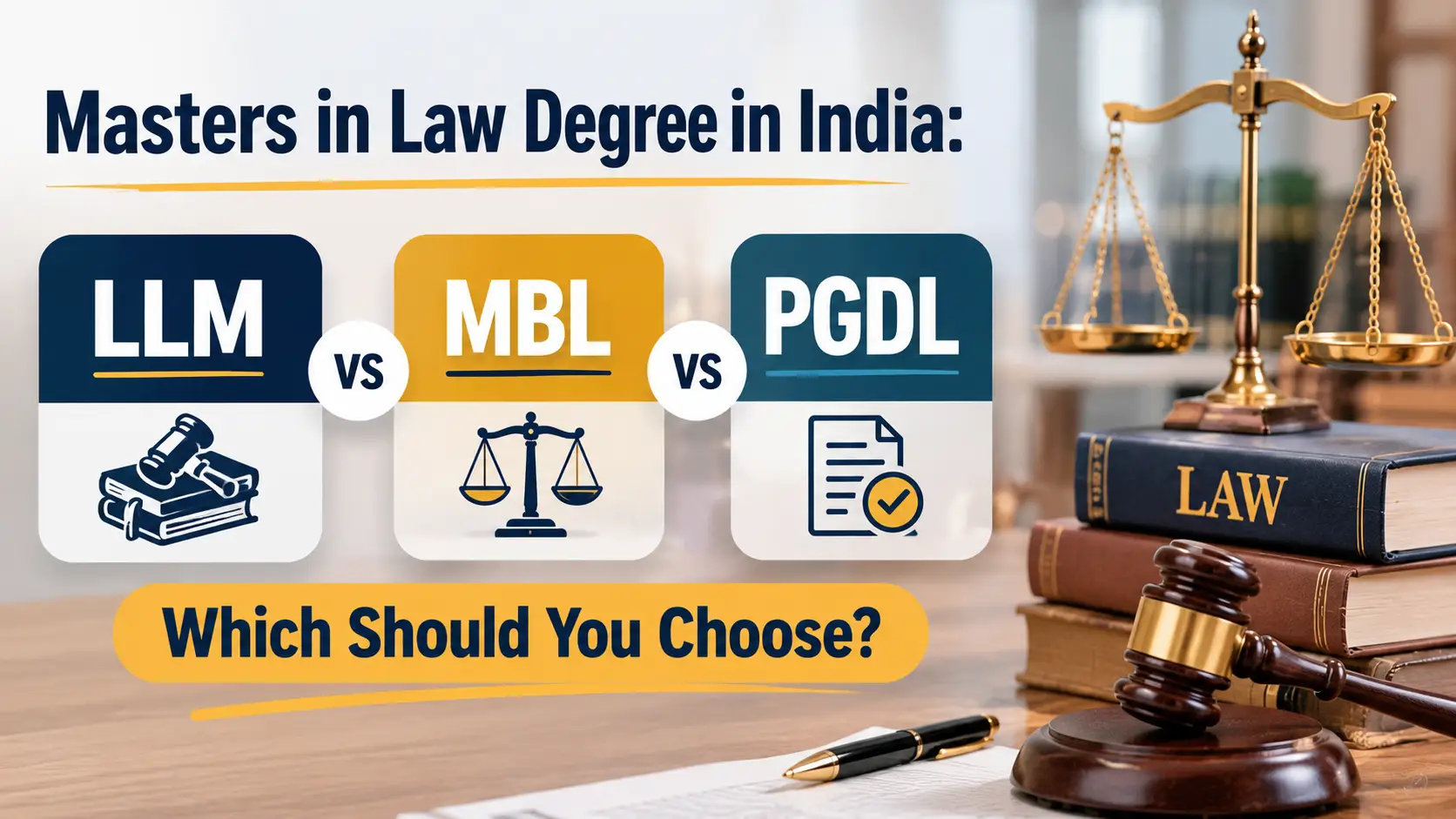
If you have a law degree (or are about to graduate) and want to pursue advanced legal qualifications, you have likely come across three options: LLM, MBL, and PGDL. They sound similar, sometimes overlap in subjects, and are often pitched as interchangeable. They are not. Each has a different purpose, different eligibility, different recognition, and very different career outcomes.
This guide breaks down all three so you can choose the right Masters in Law degree for your specific career goals in 2026.
Quick Definition: What Each Degree Means
| Degree | Full Form | Type | Duration | Available at GIL Panipat |
|---|---|---|---|---|
| LLM | Legum Magister (Master of Laws) | Master’s degree | 2 years (1 year in some cases) | Yes — 2-year regular LLM |
| MBL | Master of Business Laws | Master’s degree (specific to business law) | 1–2 years | Not offered (use general LLM + CS path) |
| PGDL | Post Graduate Diploma in Law | Diploma (not equivalent to a master’s) | 1 year (typically) | Not offered |
1. LLM (Master of Laws) — The Standard Postgraduate Law Degree
LLM is the universally recognised postgraduate degree in law, offered by virtually every law-teaching university in India. It is approved by the Bar Council of India (BCI) and the University Grants Commission (UGC).
Eligibility
- 3-year LLB or 5-year integrated law degree (BA LLB, BBA LLB, BCom LLB)
- Minimum 50–55% aggregate (varies by college)
- Entrance exam (CLAT PG, AILET PG, CUET PG, or college-specific)
Duration
Standard duration is 2 years. The 1-year LLM was permitted briefly but its status has fluctuated under BCI rulings — confirm current eligibility for academic and government positions before choosing 1-year programs.
Curriculum
Comprehensive — including jurisprudence, constitutional law, comparative law, research methodology, and electives in chosen specialisations (corporate, criminal, IP, taxation, etc.).
Recognition
- Mandatory for legal academia (university teaching)
- Required for many UGC-NET / SET law eligibility
- Recognised for PhD enrolment
- Strong professional recognition
- Recognised internationally (after equivalency where needed)
Career Value
High and broad. Suitable for academia, judicial services, corporate counsel, law firm specialist roles, civil services, and policy roles.
Typical Fees
- Public universities: ₹15,000 – ₹70,000 per year
- NLUs: ₹1.5 – 2.5 lakh per year
- Established private colleges: ₹80,000 – ₹1.5 lakh per year
- Premium private universities: ₹3 – 6 lakh per year
2. MBL (Master of Business Laws) — A Specialised Variant
MBL stands for Master of Business Laws (sometimes Master of Business Law and Administration). It is a specialised postgraduate program focused entirely on business and corporate law subjects. NLSIU Bangalore pioneered this format in India.
Eligibility
- Generally requires a graduate degree (sometimes any discipline)
- Some MBL programs are open to non-law graduates from commerce, management, finance backgrounds
- Minimum aggregate marks varying by institution
Duration
Typically 1–2 years; many MBL programs are offered as part-time, weekend, or online formats designed for working professionals.
Curriculum
Heavy focus on:
- Business contracts and commercial law
- Corporate governance
- Securities and capital markets
- Mergers and acquisitions
- Banking and financial regulations
- Competition law
- Insolvency and bankruptcy
- Tax law fundamentals
- Intellectual property in commerce
Recognition
- Recognised as a postgraduate qualification
- Not always equivalent to LLM for legal academia / judicial services purposes
- Highly valued for corporate roles and in-house counsel positions
- Recognition for PhD enrolment varies — verify before enrolling
Career Value
Targeted. Best suited for:
- Working professionals (CAs, CS, MBAs) wanting legal depth
- Lawyers seeking specialised business law expertise
- Corporate compliance and commercial roles
Typical Fees
₹1.5 – 4 lakh total program cost, depending on institution and format (full-time vs distance/online).
3. PGDL (Post Graduate Diploma in Law) — A Flexible Add-On
PGDL is a postgraduate diploma is not a master’s degree, covering specialised legal topics. Universities offer PGDLs in various focus areas: cyber law, intellectual property, taxation, labour law, corporate law, ADR, human rights, etc.
Eligibility
- Most PGDLs require a graduate degree (any discipline)
- Some are restricted to law graduates
- Often open to working professionals via distance/online mode
Duration
Typically 1 year (12 months). Some PGDLs are 6 months or 18 months.
Curriculum
Focused on a single specialisation. For example:
- PGDL in Cyber Law: IT Act, data protection, cybercrime, electronic evidence
- PGDL in IPR: patents, trademarks, copyrights, designs, GI
- PGDL in Corporate Law: Companies Act, SEBI regulations, M&A basics
- PGDL in Labour Law: industrial disputes, ESI, EPF, labour codes
- PGDL in Taxation: direct and indirect tax basics
Recognition
- Recognised as a postgraduate diploma (not a master’s degree)
- Not equivalent to LLM for academia or judicial services
- Useful as a credential addition to existing qualifications
- Helps non-law professionals (CAs, CS, HR, IT professionals) gain legal literacy in specific domains
Career Value
Adds depth in a specific niche. Best as a supplement, not a primary qualification.
Typical Fees
₹15,000 – ₹1.5 lakh total (highly variable based on institution and mode).
Side-by-Side Comparison
| Parameter | LLM (general) | LLM at Geeta Institute of Law | MBL | PGDL |
|---|---|---|---|---|
| Type | Master’s Degree | Master’s Degree | Master’s Degree (specialised) | Postgraduate Diploma |
| Duration | 2 years | 2 years | 1–2 years | 6–18 months (typically 1 year) |
| Eligibility | Law degree (LLB / 5-year integrated) | LLB / 5-year integrated, 55%+ (Haryana domicile) | Often any graduate degree | Graduate degree (varies) |
| Total Cost | ₹0.3 – 12 lakh | ~₹2 – 4 lakh (lower with GLAT scholarship) | ₹1.5 – 4 lakh | ₹0.15 – 1.5 lakh |
| Academia Eligibility | Yes (UGC-NET/PhD) | Yes (UGC-NET/PhD) | Limited (verify) | No |
| Judicial Services Weightage | Often given | Often given | Limited | Limited |
| Corporate Roles | Strong | Strong (with NCR internships) | Strong (for business law) | Adds credibility |
| Best For | Lawyers wanting full master’s | Haryana-domicile lawyers wanting affordable master’s | Working professionals + lawyers in business law | Quick specialisation add-on |
See More: How to Get Admission in LLM 2026: Eligibility, Entrance Exams & Application Tips.
Decision Framework: Which One Is Right for You?
Choose LLM if:
- You want a comprehensive master’s degree recognised everywhere
- You aim for legal academia, PhD, or research career
- You want UGC-NET / judicial services eligibility
- You are a recent law graduate looking for specialisation depth
- You want broad career flexibility (academia + practice + corporate + civil services)
Choose MBL if:
- You are a working professional (CA, CS, MBA, finance professional) wanting business law depth
- You are a lawyer wanting deep corporate specialisation without leaving work
- You don’t need academic / judicial services recognition
- You want a focused business law curriculum without the broader LLM scope
Choose PGDL if:
- You want quick legal literacy in a specific area
- You are a non-law professional adding legal credentials
- You want low-cost upskilling without committing to a full master’s
- You already have a higher law degree and want to add a niche
Common Mistakes Aspirants Make
- Treating PGDL as a master’s: A PGDL is a diploma. It does not replace an LLM for academia, judicial services, or PhD enrolment.
- Choosing MBL over LLM for academia: MBL is excellent for working professionals but may not satisfy UGC-NET / academic appointment criteria. Verify before enrolling.
- Picking the cheapest 1-year LLM without checking recognition: Some 1-year LLM programs face challenges with BCI / UGC recognition. The 2-year LLM is the safest standard.
- Ignoring entrance exam timelines: CLAT PG, AILET PG, CUET PG have fixed timelines. Missing deadlines forces aspirants into less-suitable programs.
For Most Law Graduates, LLM Is the Right Choice
If you have an LLB or 5-year integrated law degree and want to pursue a master’s qualification, the LLM remains the gold standard. It is universally recognised, opens the broadest career options, and signals serious legal expertise to employers.
The 2-year LLM gives you time for in-depth research, dissertation work, and dual specialisation through electives — a flexibility that no MBL or PGDL can match. Programs like the 2-year LLM at Geeta Institute of Law cover constitutional, corporate, criminal, and research-based subjects, preparing graduates for academia, judiciary, corporate practice, and civil services equally.
Read our guide on Top law colleges in Delhi NCR for LLM aspirants
What If I Want Both Depth and Specialisation?
The most powerful combination for many aspirants is:
- LLM (2-year) for foundational depth and recognition
- PGDL or industry certification in a specific niche (cyber law, IPR, taxation, ADR)
- Professional qualification like CS, ADIT, or ICAI tax certification (for corporate / tax tracks)
This combination delivers depth, specialisation, and industry credentials — all at a fraction of the cost of a premium specialised LLM at private universities.
Final Word
The choice between LLM, MBL, and PGDL depends entirely on your starting qualification, career goal, and time availability. For law graduates seeking a recognised, flexible postgraduate qualification with broad career options, the 2-year LLM remains the clear winner. MBL works for specific working-professional contexts. PGDL is best as an add-on, not a primary master’s substitute.
Make your choice based on facts, not marketing. Once you decide LLM is right for you, pick a college based on faculty, library, research culture, and class size — not just brand name.
Explore the apply for the 2026–27 session to begin your master’s journey.
Frequently Asked Questions
No, not strictly. MBL is a postgraduate degree but its recognition for legal academia (UGC-NET, PhD) and judicial services may be limited. Verify with the specific institution and your career goal before enrolling.
For PhD in law, LLM is the standard prerequisite. MBL recognition for PhD varies by university. PGDL is generally not sufficient for PhD enrolment in law.
Public universities (DU, BHU, JNU, state universities) offer the most affordable LLM programs — total program cost of ₹30,000 to ₹1,50,000. Among private institutions, established Haryana-based colleges like Geeta Institute of Law offer competitive pricing with merit scholarships.
The Bar Council of India has historically been restrictive about distance LLM programs. Verify current BCI status before enrolling. For working professionals, a regular 2-year LLM with some flexibility is often the safer choice.
Geeta Institute of Law offers a 2-year regular LLM program — the gold standard postgraduate law qualification. The program covers core subjects (constitutional law, corporate law, criminal law, jurisprudence, research methodology) and is suitable for academic, judicial, and practice-oriented careers.
Related Blogs
LLM Law Degree in India: Complete Guide to Specialisations, Career Scope, Salary & Admission (2026)
Everything law graduates need to know before pursuing a Master of Laws — and how…

The Rise Of LLMs (Master of Law) In India: The Transformation Of Legal Practice To Reshape The Future
In recent times, the Masters of Law has gained popularity in recent times due to…

Master Of Law Through Legal Expertise In The Heart Of India
An LLM degree is regarded as an advanced academic tool that aids legal professionals to…

How Are Courts Tackling Corporate Fraud in the Modern Era?
TABLE OF CONTENTS Introduction What Types of Corporate Fraud Are Courts Handling Today? How Are…

How to Get Admission in LLM 2026: Eligibility, Entrance Exams & Application Tips
The 2026–27 LLM admission cycle is one of the most competitive yet. With more…

BA LLB vs LLB vs LLM: Understanding the Differences & Career Opportunities
When students complete their schooling and decide to pursue a career in law, they face…