
Haryana Judiciary Exam 2026: Syllabus, Eligibility, Exam Pattern & Preparation Tips
Home / LAW / Haryana Judiciary Exam 2026: Syllabus, Eligibility, Exam Pattern & Preparation Tips
Haryana Judiciary Exam 2026 is a competitive state-level recruitment exam that selects law graduates for judicial service positions across Haryana. Conducted by the Haryana Public Service Commission, this examination is also known as HPSC Civil Judge 2026. It assesses candidates on core legal subjects and their ability to apply the law in practical situations.
Aspiring candidates are eagerly awaiting the expected date of this exam to begin their focused preparation. This year, the Haryana judiciary recruitment 2026 promises to be highly competitive and transformative for legal professionals.
What is the Haryana Judiciary Exam 2026?
Haryana Judiciary Exam is an exam conducted by the Haryana Public Service Commission (HPSC) for recruiting Civil Judges (Junior Division). Candidates are waiting for notifications related to the HPSC civil judge exam 2026. However, the notification for Haryana ADA vacancy 2026 is expected to be released with an anticipation of 255 vacancies. The notification was released in August 2025; however, it was later withdrawn following legal proceedings in court.
What is the Haryana Civil Judge Exam Pattern?
The HCS judicial branch selection process for filling vacancies involves a total of three rounds, namely the Preliminary, Mains, and Viva-Voce.
Knowing about the Haryana civil judge exam pattern is important because of the strict Haryana judiciary negative marking pattern in the first stage.
Selection Stages & Marking Scheme
| Exam Stage | Type of Exam | Total Marks | Marking & Negative Pattern |
| Preliminary | Objective (MCQs) | 500 Marks | +4 for correct; -0.80 for wrong |
| Mains | Descriptive (5 Papers) | 900 Marks | Subjective Evaluation |
| Viva-Voce | Personality Test | 200 Marks | Oral Interview |
The Preliminary exam consists of 125 questions. In addition, the Haryana civil judge exam pattern contains an extra provision called “Fifth Option.” If a candidate leaves a question unanswered, he/she must mark the Fifth circle. Otherwise, marks would be deducted from the score.
Also Read: Highest Paying Law Jobs in India 2026: Roles, Companies & Salary Packages
HCS Judicial Branch Exam Eligibility Criteria
In order to qualify for the Haryana judiciary exam 2026 registration, the candidate needs to meet certain HCS judicial branch exam eligibility criteria.
-
- Educational Qualification: One of the primary Haryana judiciary eligibility LLB degree is that the candidate must be a law graduate from a recognized university of the Bar Council of India
- Practice Requirement: In the case of All India Judges Association v Union of India, on 20 May 2025, the Supreme Court ruled that applicants for Civil Judge (Junior Division) must have practised as an advocate or law clerk for at least three years from the date of enrolment in the Bar Council of India. The ruling overturned the Court’s own ruling in 2002.
As per current HPSC guidelines, a 2-year LLM degree is counted toward the 3-year practice requirement, though candidates should verify this at the time of notification, the experience of advocates working in a corporate firm is not counted.
-
- Age Limit: The age limit for Haryana judiciary 2026, as per the current eligibility criteria, says that the candidate should be a minimum of 21 years and a maximum of 42 years as of the cutoff date.
- Relaxation: There is a relaxation of 5 years for SC/ST, BC, and certain categories of women belonging to Haryana.
- Citizenship: Candidate should either be a citizen of India, Nepal, or Bhutan.
- Language: Knowledge of Hindi (up to Matriculation level) is required to work efficiently within the state.
- Registration Fees: The fees for male candidates are ₹1000, and for female candidates are ₹250. PwBD candidates of Haryana (with at least 40% disability) are exempted.
Haryana Civil Judge Salary Structure 2026
According to the 2nd National Judicial Pay Commission, the pay scale for Civil Judge (Junior Division) varies by state. The figures below reflect the Haryana-specific structure:
| Salary Component | Amount (₹) |
| Basic Pay | 77,840 |
| Dearness Allowance (44%) | 32,693 |
| Sumptuary Allowance | 1,500 |
| Medical Allowance | 1,000 |
| Gross Monthly Salary | 1,13,033 |
| Estimated Deductions | ~21,706 |
| Net In-Hand Salary | 91,327 |
What is the Haryana judiciary syllabus 2026?
There have been several changes in the Haryana Judiciary exam 2026 syllabus due to the newly enacted criminal laws.
Mains Examination Marks Bifurcation
| Paper | Subject and Content | Maximum Marks |
| Paper I | Civil Law I: CPC, Punjab Courts Act, Contract Act, Partnership Act, Sale of Goods Act, Specific Relief Act, Haryana Rent Control Act. | 200 Marks |
| Paper II | Civil Law II: Hindu Law, Mohammedan Law, Customary Law, Law of Registration, and Limitation. | 200 Marks |
| Paper III | Criminal Law: Bhartiya Nyaya Sanhita (BNS), Bhartiya Nagarik Suraksha Sanhita (BNSS), and Bhartiya Sakshya Adhiniyam (BSA). | 200 Marks |
| Paper IV | English: Essay (1000-1100 words), Precis, Words/Phrases, Comprehension, and Corrections. | 200 Marks |
| Paper V | Hindi: Translation of English to Hindi, Explanation of Hindi passage in Devnagri, Composition (Idioms/Corrections). | 100 Marks |
| Final Stage | Viva-Voce: Personality, general outlook, and legal acumen. | 200 Marks |
| Total Score | 1100 Marks | |
Qualifying Marks
Candidates belonging to the General category are required to secure a minimum of 33% in individual papers as well as an aggregate score of 50% in the mains examination. For Reserved categories (SC/ST/BC/PH/Ex-S), a minimum score of 45% in the aggregate score of the Main exams is required. Selection is based on the cutoff list released by HPSC on its official site.
Judiciary Exam Preparation Tips Haryana
-
- Transition to New Laws: Focusing on BNS, BNSS, and BSA is key to clearing the Haryana Judiciary Exam 2026. Make a comparative chart indicating how different sections from the IPC/CrPC have been replaced by the new laws.
- Mastery in Bare Act: Winning or losing the Prelims depends upon Bare Act knowledge. Read all illustrations and exceptions thoroughly.
- Local Laws Concentration: Candidates scoring high marks in this exam usually fare exceptionally well in the Haryana Rent Control Act. These local laws carry heavy weightage in relation to the length of the act.
- Book Recommendations: The Indian Evidence Act by K.D. Gaur, the Indian Penal Code by Ratanlal & Dhirajlal, and the Civil Procedure Code by C.K. Takwani. Harshali Chowdhary’s Punjab & Haryana Land laws are important local legislation, while Dr. C.L. Khanna’s Haryana GK and Lucent’s General Knowledge are suggested for preliminary exams.
- Answer Writing: In the case of descriptive papers, write your answers in such a way that the introduction comes first, followed by the concerned section, Landmark case laws, and then a summary at last.
- Language Proficiency: Never forget Paper IV and V. Your English and Hindi scores will determine your overall rank in the exam.
People Also Read:
- AILET 2026: Syllabus, Exam Pattern, Eligibility & Preparation Tips
- How to Prepare for Judiciary Exams While Studying in 3 Year LLB Colleges in Delhi
Conclusion
Candidates are evaluated on their legal understanding, analytical ability, and overall aptitude for judicial responsibilities through this exam. While the Haryana judiciary 255 vacancies 2026 offers a lot of opportunities for the ADA cadre, the Civil Judge role still holds high prestige. The only thing needed is continuous hard work and appropriate guidance.
Those who want proper guidance regarding the exam should consider enrolling in Geeta Institute of Law. It is one of the institutes providing Judiciary coaching, and its special curriculum is designed to crack the Haryana Judiciary Exam 2026.
See Also:
Frequently Asked Questions
Haryana Judiciary Exam 2026 notification will soon be declared by the HPSC. Candidates should keep themselves aware of the HPSC website, where the Haryana Judiciary 2026 application notification will soon be available.
In the Haryana Judiciary Exam 2026, the negative marking pattern will be 1/5th of the marks. This implies that 0.80 marks will be deducted for incorrect answers. Additionally, failing to mark the Fifth Option for unattempted questions will also result in a deduction of 0.80 marks.
Now, the syllabus has been changed, including Bhartiya Nyaya Sanhita (BNS), Bhartiya Nagarik Suraksha Sanhita (BNSS), and Bhartiya Sakshya Adhiniyam (BSA) with preexisting subjects.
The basic age limit is between 21 years and 42 years. Special relaxations apply for SC/BC of Haryana, widows, and divorced women according to government guidelines.
To meet the eligibility requirements, a candidate must typically possess a law degree on or before the closing date of registration. Final-year students can apply only if their results are officially declared before the deadline.
Related Blogs

Why Sports Law is Emerging as a Popular Career Path in India?
The history of sports extends as far back as the existence of people as purposive,…

LLM Law Degree in India: Complete Guide to Specialisations, Career Scope, Salary & Admission (2026)
Everything law graduates need to know before pursuing a Master of Laws — and how…

What is International Trade Law in India?
Trade between two or more nations is covered under the area of law, International Trade…
What is Human Rights & International Humanitarian Law (HRIHL)?
Human Rights & International Humanitarian Law is a significant area of law that safeguards human…
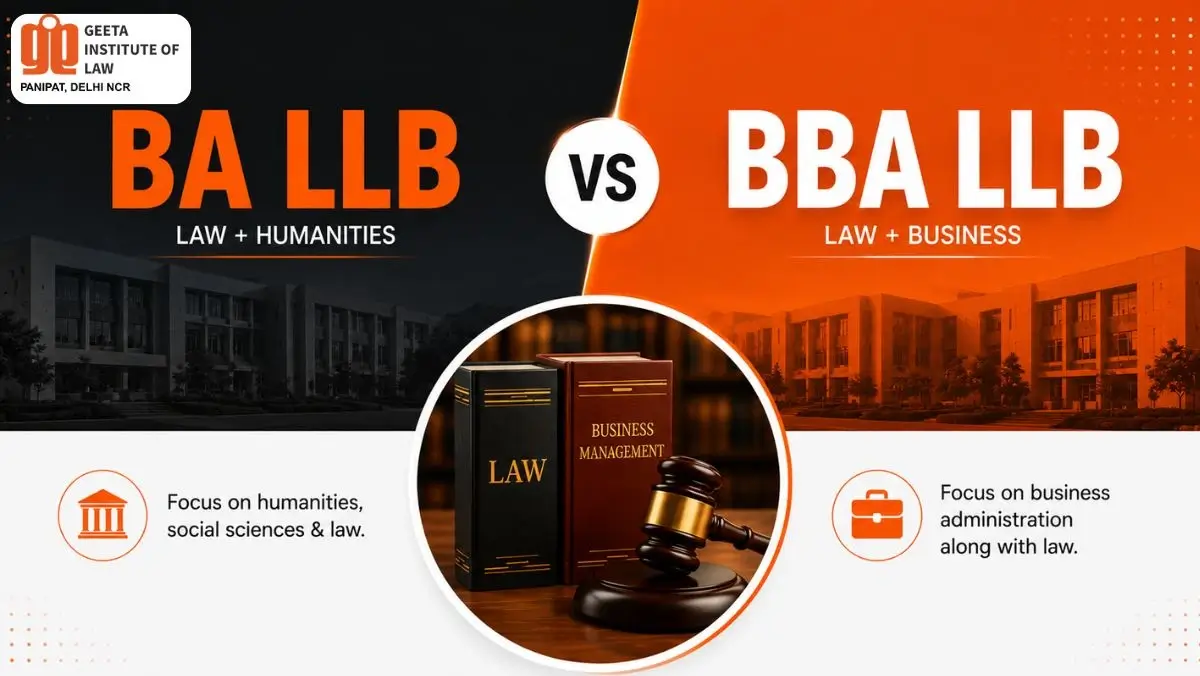
BA LLB vs BBA LLB: Which Course is Right for You After 12th?
Many students who want to make a career in law have two choices and are…
Law Admission 2026 | Your Ultimate Admission Roadmap
Law entrance exams offer a chance to enrol in both undergraduate and graduate programs at…