
Advocate on Record (AOR): Eligibility, Exam Pattern & How to Become One
Home / LAW / Advocate on Record (AOR): Eligibility, Exam Pattern & How to Become One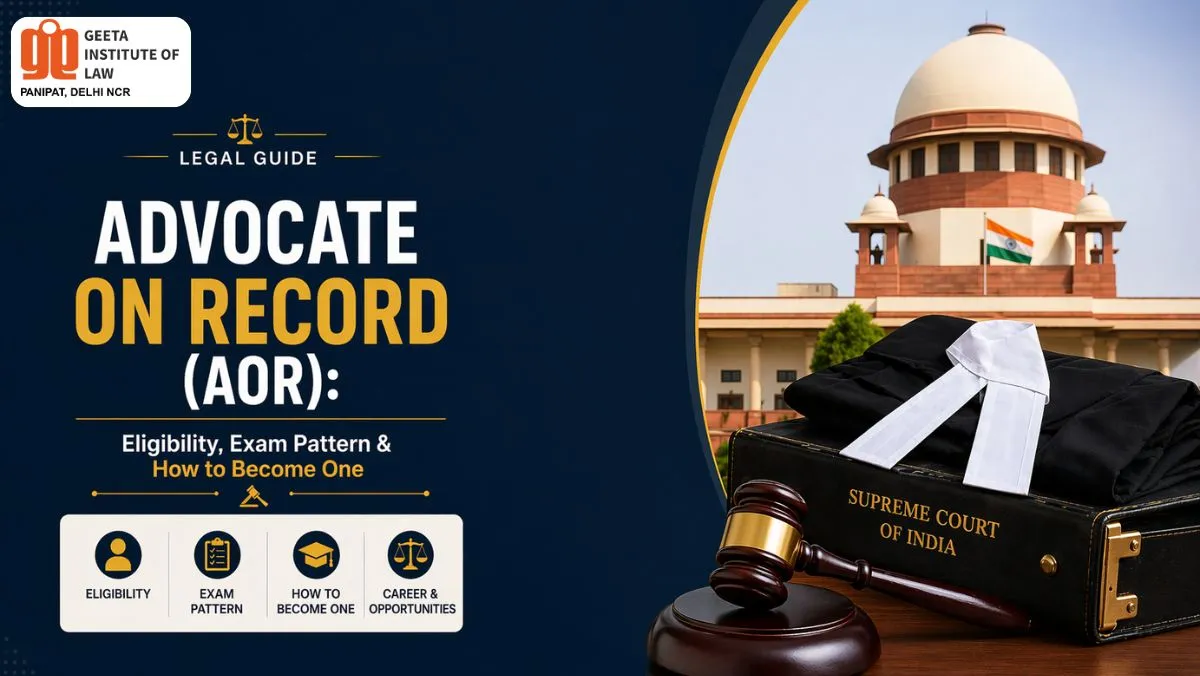
For legal experts, being an Advocate-on-Record (AOR) at the Supreme Court of India is a major career milestone. However, it may be challenging to navigate the stringent qualifying standards. Success in this esteemed Supreme Court AOR exam depends on knowing precisely who is eligible to take the exam and how to fulfil all the requirements.
This thorough guide explains SC AOR exam eligibility and syllabus, including experience and educational requirements for becoming an AOR in Supreme Court.
Who is an AOR?
Advocate-on-Record is the AOR full form in court. A lawyer who has completed the Supreme Court of India’s Advocate-on-Record Examination is known as an AOR, and they are the only ones permitted to file cases and appear before the Supreme Court by passing this exam. No other advocate may independently initiate proceedings, make an appearance, or represent a party before the Supreme Court; only an AOR is permitted to do so.
AOR Exam Eligibility Criteria
Candidates who intend to appear in the exam should first understand the advocate on record eligibility. The Supreme Court AOR exam eligibility provides a clear picture of the necessary conditions before applying.
Here are the significant requirements for the Advocate-on-Record exam that every aspirant must know about:
| Category | Requirement | Details |
| Educational Qualifications | Law Degree | LL.B. (3-year or 5-year integrated) in an approved institution of the Bar Council of India (BCI). |
| Practice eligibility for the AOR exam | AIBE Requirement | Must clear All India Bar Examination (AIBE); not required if LL.B. completed before 2010. |
| AOR Exam Experience | Minimum of 4 years of enrolment as an advocate. | |
| Practice Nature | Continuous practice without interruption or suspension. | |
| Work Requirement | Personal appearances in Indian courts/tribunals. | |
| Legal Basis | Enrolment under the Advocates Act, 1961. | |
| Verification | Practice certified by the Supreme Court Registry. | |
| Documentation for Supreme Court AOR Exam | Bar Council Certificate | State Bar Council certificate of date of enrolment and practice. |
| Validity | Certificate should be recent (usually within 6 months). | |
| Compliance | Should verify no outstanding disciplinary action. | |
| Training Requirement | Duration | 1-year mandatory training |
| Mentor | Training under a Senior Advocate-on-Record (AOR) with a minimum of 10 years’ experience. |
Documents needed to start AOR Training
When you start training with a senior AOR for the Supreme Court AOR Exam, you must submit these papers to the AOR Examination cell:
- Your original State Bar Council continuity certificate
- Your State Bar Council Enrolment Certificate (self-attested)
- Your State Bar Council Certificate of Practice (self-attested copy) (not necessary for pre-AIBE applicants)
- A letter on your letterhead advising the AOR Exam Cell of your training commencement.
- Commencement Certificate from the senior AOR alerting the AOR Exam Cell of your training start.
- Submit these papers within 7 days after receiving the Commencement Certificate.
- After clearing the AOR exam, you must register an office within 16 km of the Supreme Court.
Anyone may give these documents to the AOR Exam Cell on your behalf in Delhi. Make sure they get a receipt from the officer when submitting paperwork.
AOR Exam Pattern & Marking Scheme
The AOR Exam Pattern provides the format, time, and marking pattern of all four papers. Refer to the table below:
| Particulars | Description |
| Total Number of Papers | 4 papers |
| Subjects Covered | Paper 1: Practice and Procedure of the Supreme Court
Paper 2: Drafting Paper 3: Professional Ethics and Advocacy Paper 4: Leading Cases |
| Total Marks | 400 |
| Minimum Passing Marks | 45 marks per paper (45%), with an overall aggregate of 50% |
| Marks per Paper | 100 marks each |
| Exam Duration | 3 hours (Papers 1 & 2), 2 hours (Papers 3 & 4) |
| Mode of Exam | Written examination |
| AOR Exam Fees | ₹750 |
| Qualifying Criteria | Minimum passing marks required in each paper |
| Nature of Questions | Descriptive and application-based |
What is the Syllabus for the Supreme Court AOR Exam?
The Supreme Court AOR exam syllabus is divided into four papers: procedure, drafting, ethics, and leading cases.
See the table below:
| Paper | Paper Name | Key Topics Covered |
| Paper 1 | Practice and Procedure of the Supreme Court | Constitutional (Articles 124 to 147), writ (Article 32), original and appellate jurisdiction, Public Interest Litigation, review and contempt (Article 141), Supreme Court Rules, CPC, Limitation Act, court fees. |
| Paper 2 | Drafting | Article 131 SLPs and statements of cases, decrees and writs, appeals and pleadings, review petitions (Article 137), transfer petitions (CPC), Article 139 and CrPC Section 406, contempt petitions (Article 129), interlocutory applications, bail, delay condonation, exemption applications. |
| Paper 3 | Professional Ethics | Advocates Act and disciplinary matters, contempt cases involving advocates, Bar Council of India Rules, and Supreme Court Rules 2013. |
| Paper 4 | Leading Cases | Notable Supreme Court decisions, as mandated by the Supreme Court, are to be studied in detail. |
Recommended AOR Exam Books & Study Material
- Supreme Court Rules, 2013 (including 2017 amendments)
- Commentary on the Code of Civil Procedure by Mulla
- Bar Council of India Rules
- Advocates Act, 1961, with commentary
- Previous year AOR exam question papers
- Leading cases prescribed by the Supreme Court
Additional Study Resources
- Supreme Court Practice and Procedure Handbook
- Past 5 to 10 years papers
- AOR Exam preparation lectures by the Supreme Court
- Study notes by Senior Advocate Maninder Singh
In the event that students feel that self-study is difficult, they may rely on the assistance of AOR coaching in Delhi.
Step-by-Step Process to Become an AOR
Qualifying for the Supreme Court AOR Exam requires meeting strict legal and procedural requirements. Each step ensures that the candidate is qualified to practise before the Supreme Court of India.
Step 1: Complete your LL.B. degree (3-year or 5-year integrated)
Obtain a law degree from a university recognised by the Bar Council of India.
Step 2: Clear the All India Bar Examination (AIBE)
Qualify the AIBE to practise as an advocate.
Step 3: Enrol with a State Bar Council
Get enrolled as an advocate under the Advocates Act, 1961.
Step 4: Practice as an advocate for a minimum of 4 years
Undertake continuous legal practice with active appearance before courts and tribunals.
Step 5: Find a senior AOR with 10+ years of experience for training
Engage under a Senior Advocate-on-Record with the prescribed standing.
Step 6: Complete 1 year of mandatory training under the senior AOR
Fulfil the compulsory training requirement in accordance with Supreme Court norms.
Step 7: Submit required documents to the AOR Exam Cell within 7 days
File all requisite documents within the stipulated time frame.
Step 8: Register and appear for the AOR Examination
Apply in the prescribed manner and appear for all four papers.
Step 9: Clear all 4 papers and receive your AOR designation
Qualify each paper to be designated as an Advocate-on-Record by the Supreme Court.
Conclusion
The most esteemed and sought-after position for an Indian lawyer is advocate on record. An AOR’s function before the Supreme Court is crucial; therefore, obtaining such a designation requires a complete legal education, practical experience, and legal system knowledge.
At the top ranked law colleges in India, the Faculty of Law trains the future generation of attorneys with the knowledge, abilities, and drive to succeed in the legal profession and become Advocates-on-Record.
Click here to explore law programs if you’re interested in becoming an advocate on record.
Frequently Asked Questions
Basic qualifications include being an advocate with a legal degree, passing the All-India Bar Exam (AIBE), enrolling in any State Bar Council for at least 4 years before training, and 1 year of training under a senior AOR with 10 years of experience.
No higher age restriction applies to AOR applications. A 25-year-old and a 60-year-old advocate are equally eligible as long as they meet the practice and training requirements.
It is widely regarded as harder than judiciary exams and most state bar council exams. The 20% pass rate makes it comparable in difficulty to the UPSC Civil Services exam in terms of selectivity, though the subject matter is entirely legal.
No, the Supreme Court AOR Exam requires experience as an advocate registered with a State Bar Council in India, appearing before Indian courts or tribunals. The four-year practice minimum does not include overseas experience.
The AOR exam eligibility for advocates requires a minimum of four years of practice as an advocate.
Related Blogs
Sports Law in India: Courses, Colleges, & Career Scope
This paper discusses how sports law has evolved in the growing sports industry in India,…

What is Civil Law in India? Courses, Admission Process, Best Colleges & Career Scope
Among the most well-liked areas of law is Civil Law, which helps resolve various non-criminal…
Top 10 Private Law Colleges in India 2026 | Fees, Ranking & Admission
Law grads can work in a lot of different fields, such as business law companies,…

CBSE 12th Result 2026 Declared! Check Your Scorecard Right Now
The CBSE Class 12 Result 2026 has been officially announced on 13th May 2026. Students…

How Law Schools Are Preparing Students for a Technology-Oriented Legal Profession
Legal professionals, surrounded by massive bookshelves and piles of papers, are slowly disappearing. The legal…

What Do Lawyers Actually Do? Exploring the Different Career Paths in Law
The legal market today covers far more than courtroom advocacy. Lawyers have roles across business,…